
A cell is a source of electric current in the electrical circuit. The Potential Difference between terminals of a cell in an open circuit (when no current is drawn) is called electromotive force (emf) of the cell. When electrical circuit is closed and current is drawn from the terminal Potential Difference between two terminals is called terminal potential difference (v) of the cell. The cells can be connected in series as well as in parallel combinations. Like resistor cell also offers opposition to the flow of current. This opposition offered by cell is called internal resistance of the cell.
Three cells, each of emf ε and internal resistance r are connected with external resistor R as shown in fig. The value of current (I) flowing in the circuit will be:
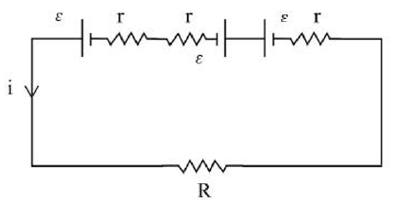
Answer & explanation
Correct answer: option 3
The correct answer is Option (3) → \(\frac{ε}{R+3r}\)
According to Kirchoff's current law (KCL): Conservation of Charge
Statement: At any junction (node) in an electrical circuit, the sum of currents flowing into the junction is equal to the sum of current flowing out of the junction.
$∑I_{in}=∑I_{out}$
or $∑I=0$ (Considering Direction)
According to Kirchoff's Junction law (KCL): Conservation of Energy
Statement: In a closed loop of a circuit, the sum of electromotive force (emfs) is equal to the sum of potential drops (voltage drops)
$∑I=0$ (Considering Direction)
$ε-IR-Ir+ε-ε-Ir-Ir=0$
$ε-IR-3Ir=0$
$ε=I(R+3r)$
$I=\frac{ε}{R+3r}$