What would be the expected product when dimethyl ether is treated with \(HI\) in excess
Answer & explanation
Correct answer: option 2
The correct answer is Option (2) → Methyl iodide only
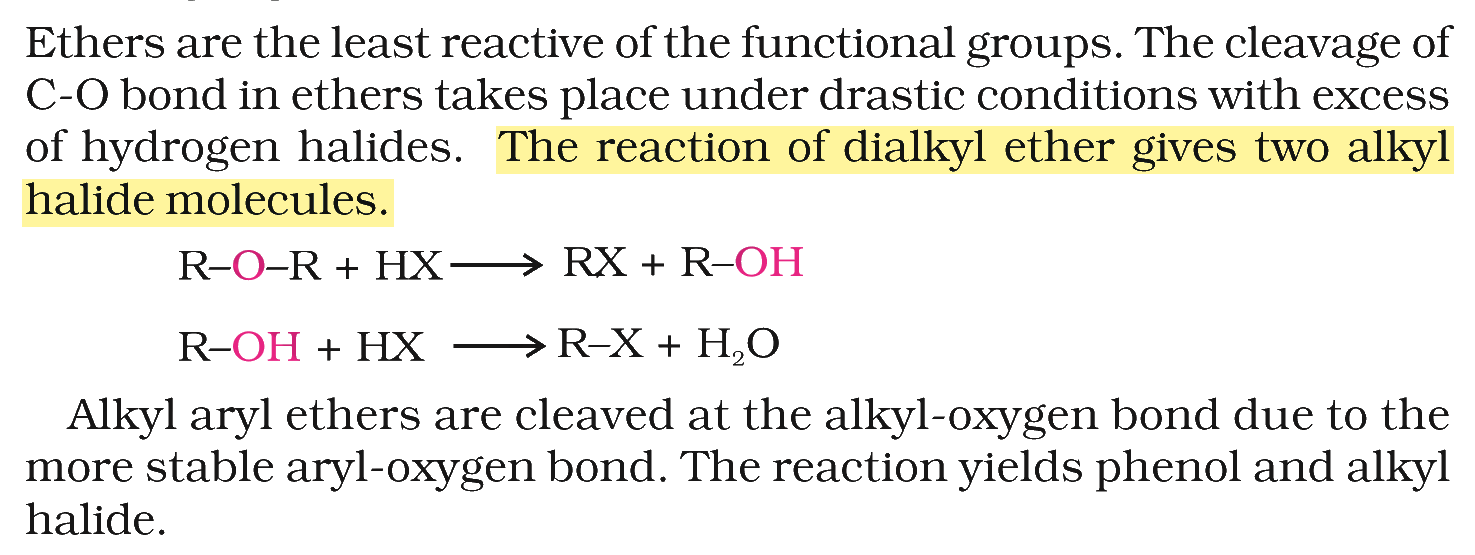
Ethers are cleaved at the C–O bond only under drastic conditions, by excess of a hydrogen halide (reactivity HI > HBr > HCl). With one mole of HI a dialkyl ether gives an alkyl iodide and an alcohol; with excess HI the alcohol formed also reacts, so a dialkyl ether finally gives two molecules of alkyl iodide.
For dimethyl ether:
\( \displaystyle \ce{CH3-O-CH3 + HI -> CH3I + CH3OH} \)
\( \displaystyle \ce{CH3OH + HI -> CH3I + H2O} \)
With excess HI, the net reaction is:
\( \displaystyle \ce{CH3-O-CH3 + 2HI} \xrightarrow{\Delta} \ce{2CH3I + H2O} \)
The first step begins with protonation of the ether oxygen; iodide ion, a good nucleophile, then attacks the methyl carbon (SN2). Both alkyl groups are methyl, so the only organic product is methyl iodide.
Why the other options are incorrect
Option (1) Methyl alcohol and Methyl iodide — Incorrect. These are the products with one mole of HI. In excess HI the methyl alcohol is converted into a second molecule of methyl iodide.
Option (3) Ethyl alcohol only — Incorrect. Dimethyl ether contains no ethyl group; ethyl compounds come from diethyl ether.
Option (4) Ethene only — Incorrect. HI cleaves the C–O bond by substitution, not elimination; a methyl group cannot give an alkene at all.
NCERT (2026-27 edition):
Cleavage of C–O Bond in Ethers