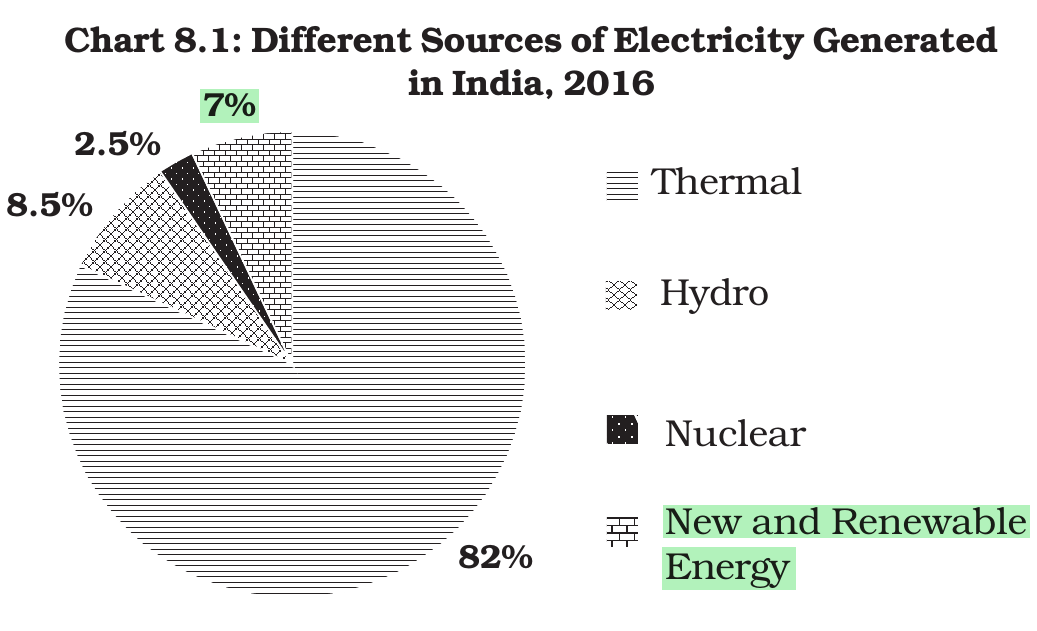
Following are the sources of electricity generation in India. Arrange them in correct sequence on the basis of total power generation capacity (higher to lower):
(A) Nuclear
(B) Thermal
(C) New and renewable energy
(D) Hydro
Choose the correct answer from the options given below:
Answer & explanation
Correct answer: option 4
The correct answer is Option (4) → (B), (D), (C), (A)
(B) Thermal — 82 per cent of the power generation capacity
(D) Hydro — 8.5 per cent
(C) New and renewable energy — 7 per cent
(A) Nuclear — 2.5 per cent
Note 1: This question is taken from the chapter ‘Infrastructure’ which was there in the pre-rationalised NCERT and has been deleted from subsequent editions of NCERT. The chapter was also not in the CUET (UG) 2026 syllabus.
Note 2: These shares are the figures printed in that book, in its text for 2018 and its chart for 2016. Such shares change from year to year, and the answer here follows the book’s figures.
NCERT (Pre-rationalised): “Power/Electricity: The most visible form of energy, which is often identified with progress in modern civilisation, is power, commonly called electricity. It is a critical component of infrastructure that determines the economic development of a country.… …In India, in 2018, thermal sources accounted for 82 per cent of the power generation capacity. Hydel power accounted for 8.5 per cent, while nuclear power accounted for only 2.5 per cent.…”
|