
CUETMOCK
  • Pricing
  • Mentors
Log inStart freeStart free mocks→

First test, then trust

Try a free CUET mock test.

Join 5,00,000+ students who rehearsed exam day on the exact NTA screen before sitting CUET. On the web and on Android.

Start free mocks →Get the Android app
CUETMOCK

India's #1 CUET Mock Test Platform. Original NCERT-based questions on the exact NTA exam screen — trusted by 5,00,000+ students since CUET 2022.

Get it onGoogle PlayScan to download the CUETMOCK app

Mock tests

  • CUET mock test series
  • Commerce mocks
  • Humanities (Arts) mocks
  • Science mocks
  • Languages & GAT mocks
  • Free practice questions
  • Pricing

Resources

  • CUET exam guide
  • CUET syllabus
  • Universities accepting CUET
  • Expert blogs
  • News & notifications
  • Webinars & counselling
  • CUET score calculator
  • How we estimate your rank
  • FAQs

Company

  • About us
  • Our leadership & team
  • Our toppers
  • Mentors
  • For schools
  • Contact us
  • Terms
  • Privacy
  • Refund policy

Talk to us

+91 7696 6630 56info@cuetmock.comWhatsApp us

Our other platforms

  • JEE Mock — For IIT-JEE aspirants
  • NEET Mock — For NEET aspirants

Newsletter

Exam updates, study material and offers — no spam.

© 2026 NYC Ventures Pvt. Ltd.

701-702, Royal Business Park, Zirakpur, Punjab - 140603

  • Terms of use
  • Privacy policy
  • Refund policy
  • Contact us

iCUETMOCK is an independent preparation platform, not affiliated with the National Testing Agency (NTA). Always check exam details on the official NTA website.

  • Home
  • Mock tests
  • CUET guide
  • Pricing
  • Log in
Home/Practice questions/Chemistry
ChemistryPhysical: Chemical Kinetics

Which of the following is true for catalysts?

Which of the following is true for catalysts?

Answer & explanation+

Correct answer: option 3

The correct answer is Option (3) → It provides an alternate pathway or reaction mechanism.

A catalyst increases the rate of a reaction without being used up. It does this by providing an alternate pathway (reaction mechanism) with a lower activation energy. More molecules then have enough energy to react, so the reaction becomes faster.

A catalyst takes part in the steps of the reaction but is regenerated at the end. It lowers the energy barrier equally for the forward and the backward reactions and does not change the energies of the reactants or the products.

Why the other options are incorrect

  • Option (1) It alters the equilibrium constant. — Incorrect. A catalyst speeds up the forward and backward reactions equally, so equilibrium is reached sooner, but the equilibrium constant is not changed.

  • Option (2) It catalyzes non-spontaneous reaction. — Incorrect. A catalyst can speed up only a reaction that is already spontaneous (ΔG negative); it cannot make a non-spontaneous reaction take place.

  • Option (4) It alters the Gibbs free energy of a reaction. — Incorrect. ΔG depends only on the initial and final states, which a catalyst does not change.

NCERT (2026-27 edition):
Effect of Catalyst – “… It is believed that the catalyst provides an alternate pathway or reaction mechanism by reducing the activation energy between reactants and products and hence lowering the potential energy barrier …. It is clear from Arrhenius equation (3.18) that lower the value of activation energy faster will be the rate of a reaction. A small amount of the catalyst can catalyse a large amount of reactants. A catalyst does not alter Gibbs energy, ΔG of a reaction. It catalyses the spontaneous reactions but does not catalyse non-spontaneous reactions. It is also found that a catalyst does not change the equilibrium constant of a reaction rather, it helps in attaining the equilibrium faster, that is, it catalyses the forward as well as the backward reactions to the same extent so that the equilibrium state remains same but is reached earlier.”
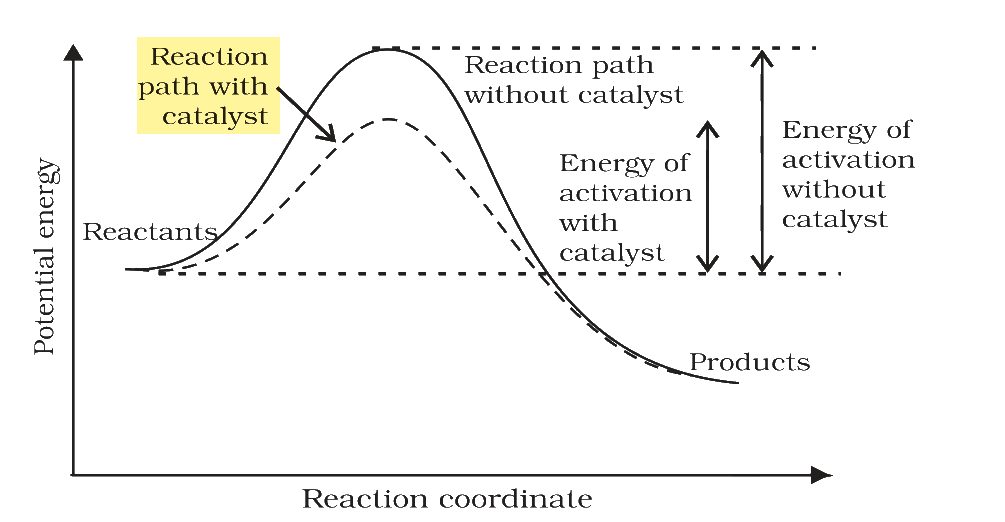
Textbook figure

Advertisement

Practise more on Physical: Chemical Kinetics

Chapter-wise mocks on the real NTA exam screen, with solutions and your rank. Your first mocks are free.

Start free mocks →

Advertisement

Next questions

  1. A train starts from a place at 10:00 a.m. and arrives at another place T at 2:30 p.m. on the same day. If the speed of the train is 40 m/se…General Aptitude Test · Numerical Ability
  2. A convex lens ≤ft(n_g = 1.5) of focal length 10 cm in air when immersed in a liquid behaves as a diverging lens of focal length 45 cm. The…Physics · Ray Optics
  3. In which of the following sentences is the underlined when-clause an adverb clause?(A) Amma turned off the gas when the milk began to boil…English · Grammar: Clauses
  4. Match the person in List- I with description in List- II: List- I (Person) List- II (Description) (A) Shuja (I) also called Nadir ul Asr (B…Fine Arts · The Mughal School of Miniature Painting
  5. Select the option in which the words share the same relationship as that shared by the given pair of words. Stringent : FlexibleGeneral Aptitude Test · General Ability
  6. The given table represents the sale (in thousands) of cars by four companies A, B, C and in six years. Study the table and answer the quest…General Aptitude Test · Quantitative Reasoning
  7. How much charge is required for the reduction of one mole of MnO4- to Mn2+?Chemistry · Physical: Electro Chemistry
  8. In the poem, the speaker looks at the tiger mainly withEnglish · Comprehension - (Poetry / Literary)
  9. कहै कवि बेनी, बेनी व्याल की चुराई लीनी। पंक्ति में कौन-सा अलंकार है -Hindi · Alankar
  10. Consider the following statements about situationism.(A) Situationism states that situations and circumstances in which one is placed influ…Psychology · Variations in Psychological Attributes