Phenol
Aniline reacts with nitrous acid at 273- 278 K followed by treating with dilute acid gives a compound A. Compound A reacted with bromine water gives a Compound B as a white precipitate. Compound A reacts with Zinc dust to give compound C. Compound C reacts with Cl2 in the presence of Lewis acid to give compound D. Further, Compound A undergoes oxidation with chromic acid to give compound E.
What is the structure of compound C?
Answer & explanation
Correct answer: option 1
The correct answer is Option (1) → benzene
The passage describes a chain of reactions that starts from aniline. Each step, with its full equation:
A (phenol): aniline is diazotised with nitrous acid (from NaNO2 + HCl) at 273–278 K, and the diazonium salt is hydrolysed by warming with dilute acid.
\( \displaystyle \ce{C6H5NH2 + NaNO2 + 2HCl} \xrightarrow{\text{273-278 K}} \ce{C6H5N2^+Cl^- + NaCl + 2H2O} \)
\( \displaystyle \ce{C6H5N2^+Cl^- + H2O} \xrightarrow{\text{warm, dil. acid}} \ce{C6H5OH + N2 ^ + HCl} \)
B (2,4,6-tribromophenol): phenol with bromine water gives a white precipitate.
\( \displaystyle \ce{C6H5OH + 3Br2} \xrightarrow{\ce{H2O}} \ce{C6H2Br3OH v + 3HBr} \)
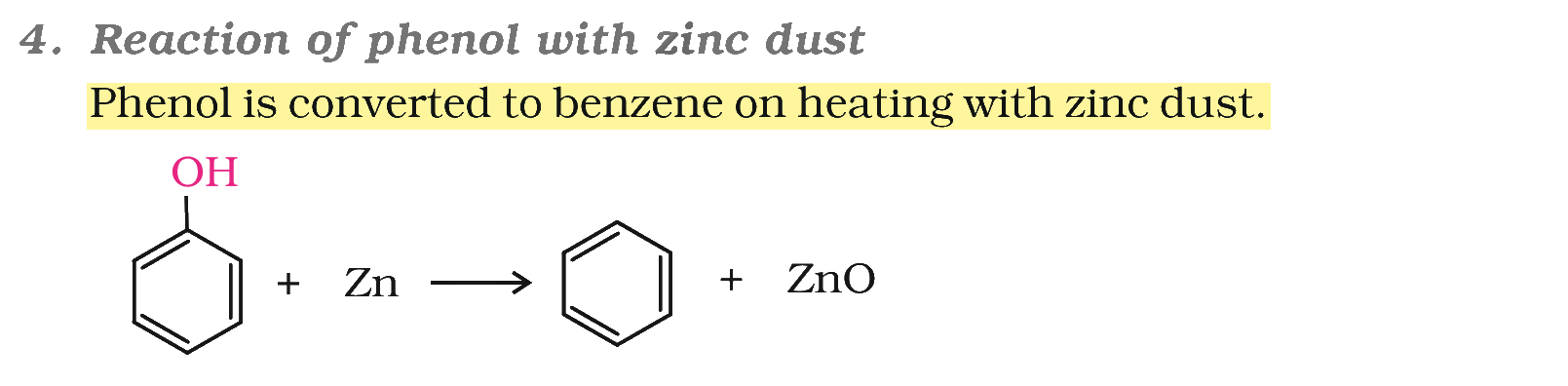
C (benzene): phenol heated with zinc dust loses its oxygen.
\( \displaystyle \ce{C6H5OH + Zn} \xrightarrow{\Delta} \ce{C6H6 + ZnO} \)
D (chlorobenzene): benzene with Cl2 and a Lewis acid undergoes electrophilic substitution.
\( \displaystyle \ce{C6H6 + Cl2} \xrightarrow{\text{anhyd. }\ce{FeCl3}} \ce{C6H5Cl + HCl} \)
E (benzoquinone): phenol is oxidised by chromic acid to the conjugated diketone.
\( \displaystyle \ce{C6H5OH + 2[O]} \xrightarrow{\ce{Na2Cr2O7}/\ce{H2SO4}} \underset{\text{benzoquinone}}{\ce{C6H4O2}} + \ce{H2O} \)
Why the other options are incorrect
Option (2) cyclohexa-1,4-diene — Incorrect. Zinc dust only removes the oxygen; it does not add hydrogen to the ring, so no cyclohexadiene is formed.
Option (3) cyclohexene — Incorrect. The ring is not hydrogenated, so cyclohexene is not formed.
Option (4) cyclohexane — Incorrect. Cyclohexane would need complete hydrogenation of the ring (for example, \( \ce{H2} \) with a Ni catalyst); zinc dust does not do this.
NCERT (2026-27 edition):
Reaction of Phenol with Zinc Dust