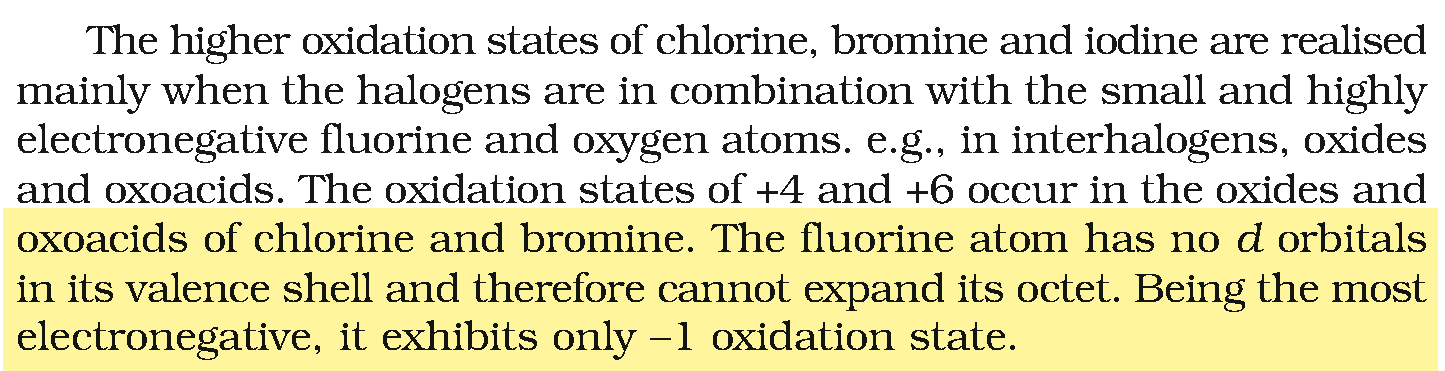
Why does Fluorine exhibit only −1 oxidation state ?
Answer & explanation
Correct answer: option 4
The correct answer is Option (4) → It has no d orbitals.
The other halogens (Cl, Br, I) show positive oxidation states of +1, +3, +5 and +7 as well as −1. In these higher states the halogen uses vacant d orbitals of its valence shell: electrons are promoted into the d orbitals, so that 3, 5 or 7 unpaired electrons become available for bonding.
Fluorine (Z = 9) is 1s2 2s2 2p5. Its valence shell (n = 2) has no d orbitals, so no electrons can be promoted and only one unpaired electron is ever available.
Why the other options are incorrect
Option (1) It is a halogen. — Incorrect. Cl, Br and I are halogens too, but they also show positive oxidation states.
Option (2) It is a non-metal. — Incorrect. Many non-metals (N, S, Cl) show positive oxidation states as well.
Option (3) It is small in size. — Incorrect. Small size explains several anomalous properties of fluorine (low F–F bond enthalpy, high hydration enthalpy), but the reason it cannot show positive oxidation states is the absence of d orbitals together with its highest electronegativity.
Note: This question is from the pre-rationalised NCERT book (2022-23). The topic is not there in the latest NCERT book (2026-27), and it is also out of the CUET 2026 syllabus.
NCERT (Pre-rationalised edition, 2022-23):
Chemical Properties – …