
CUETMOCK
  • Pricing
  • Mentors
Log inStart freeStart free mocks→

First test, then trust

Try a free CUET mock test.

Join 5,00,000+ students who rehearsed exam day on the exact NTA screen before sitting CUET. On the web and on Android.

Start free mocks →Get the Android app
CUETMOCK

India's #1 CUET Mock Test Platform. Original NCERT-based questions on the exact NTA exam screen — trusted by 5,00,000+ students since CUET 2022.

Get it onGoogle PlayScan to download the CUETMOCK app

Mock tests

  • CUET mock test series
  • Browse all papers
  • Commerce mocks
  • Humanities (Arts) mocks
  • Science mocks
  • Languages & GAT mocks
  • Free practice questions
  • Pricing

Resources

  • CUET exam guide
  • CUET syllabus
  • Universities accepting CUET
  • Expert blogs
  • News & notifications
  • Webinars & counselling
  • CUET score calculator
  • How we estimate your rank
  • FAQs

Company

  • About us
  • Our leadership & team
  • Our toppers
  • Mentors
  • For schools
  • Contact us
  • Terms
  • Privacy
  • Refund policy

Talk to us

+91 7696 6630 56info@cuetmock.comWhatsApp us

Our other platforms

  • JEE Mock — For IIT-JEE aspirants
  • NEET Mock — For NEET aspirants

Newsletter

Exam updates, study material and offers — no spam.

© 2026 NYC Ventures Pvt. Ltd.

701-702, Royal Business Park, Zirakpur, Punjab - 140603

  • Terms of use
  • Privacy policy
  • Refund policy
  • Contact us

iCUETMOCK is an independent preparation platform, not affiliated with the National Testing Agency (NTA). Always check exam details on the official NTA website.

  • Home
  • Mock tests
  • CUET guide
  • Pricing
  • Log in
Home/Practice questions/Chemistry
ChemistryPhysical: Electro Chemistry

Consider the standard reduction potentials (in volts) as shown in fig…

Consider the standard reduction potentials (in volts) as shown in figure. Find E°.

Answer & explanation+

Correct answer: option 3

The correct answer is option 3. 0.756 V.

The reaction scheme is

This can be broken down into
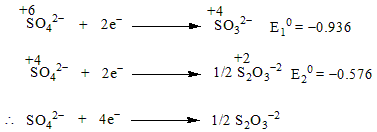
We know,

\(nE^0 = n_1E_1^0 + n_2E_2^0\)

\(E^0 = \frac{−2 × 0.936 − 2 × 0.576}{4}\)

or, \(E^0 = −0.756 V\)

Advertisement

Practise more on Physical: Electro Chemistry

Chapter-wise mocks on the real NTA exam screen, with solutions and your rank. Your first mocks are free.

Start free mocks →

Advertisement

Next questions

  1. In which state of India, is the Chapchar Kut festival celebrated?General Aptitude Test · General Knowledge
  2. The area of a triangle whose vertices are (x_1,y_1), (x_2,y_2) and (x_3,y_3) is given by the absolute value ofMaths. Section B1 · Determinants
  3. Match List-I with List-IIList-IList-IIItemAcid(A) Vinegar(I) Citric Acid(B) Orange(II) Tartaric Acid(C) Tamarind(III) Oxalic Acid(D) Tomato…General Aptitude Test · General Knowledge
  4. On a certain sum of money, the simple interest for 2 years is Rs. 660 and the compound interest for the same period is Rs. 696.30. If the r…General Aptitude Test · Numerical Ability
  5. According to the right to personal liberty, what must happen when a person is arrested?Political Science · Rights In The Indian Constitution
  6. What is Manohar's most significant work during Jagat Singh I's reign?Fine Arts · The Rajasthani Schools of Painting
  7. Select the correctly spelt word.English · Spelling Check
  8. A train passes a pole in 15 seconds and a platform 100 m long in 25 seconds. Then find the length of the train.General Aptitude Test · Numerical Ability
  9. Steel sheets are used for making automobiles and copper used for making utensils, what type of goods are these (Steel and Copper)?Economics · Macro Economics: National Income Accounting
  10. If f(x) =∫limits_0^x(t+1) (e^t –1) (t – 2) (t + 4) dt then f(x) would assume the local minima atMaths. Section B1 · Applications of Derivatives