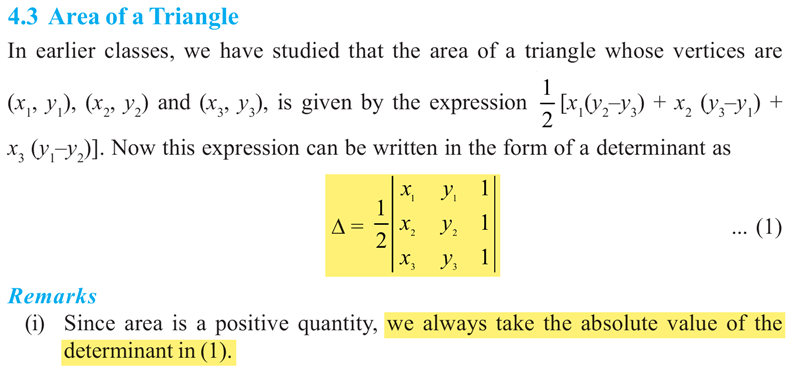
The area of a triangle whose vertices are \((x_1,y_1), (x_2,y_2)\) and \((x_3,y_3)\) is given by the absolute value of
Answer & explanation
Correct answer: option 1
The correct answer is Option (1) → \(\Delta=\displaystyle\frac{1}{2}\begin{vmatrix}x_1&y_1&1\\x_2&y_2&1\\x_3&y_3&1\end{vmatrix}\)
The coordinate formula for the area of a triangle is
\(\displaystyle \Delta = \frac{1}{2}\left[x_1(y_2 - y_3) + x_2(y_3 - y_1) + x_3(y_1 - y_2)\right]\)
Expanding the determinant with a column of 1s along that column gives exactly this bracket:
\(\displaystyle \begin{vmatrix}x_1&y_1&1\\x_2&y_2&1\\x_3&y_3&1\end{vmatrix} = x_1(y_2 - y_3) + x_2(y_3 - y_1) + x_3(y_1 - y_2)\)
So \(\Delta = \frac{1}{2}\) of this determinant, and the area is its absolute value (the sign depends only on the order of the vertices).
Why the other options are incorrect
Option (2) \(\Delta=\begin{vmatrix}x_1&y_1&1\\x_2&y_2&1\\x_3&y_3&1\end{vmatrix}\) — Incorrect. The factor \(\frac{1}{2}\) is missing; this is twice the area.
Option (3) \(\Delta=\displaystyle\frac{1}{2}\begin{vmatrix}x_1&y_1&1\\x_2&y_2&0\\x_3&y_3&0\end{vmatrix}\) — Incorrect. Expanding along the last column gives \(\frac{1}{2}(x_2y_3 - x_3y_2)\), which does not involve \((x_1, y_1)\) at all.
Option (4) \(\Delta=\begin{vmatrix}x_1&y_1&1\\x_2&y_2&0\\x_3&y_3&0\end{vmatrix}\) — Incorrect. It equals \(x_2y_3 - x_3y_2\), again independent of the first vertex.
NCERT (2026-27 edition):
Area of a Triangle