Aspirin is a commonly used non-steroidal anti-inflammatory drug which reduces fever, relieves mild pain and decreases swelling. It is prepared by numerous synthetic methods; of which the acetylation of Compound A with acetyl chloride is one of the easiest methods. However, Compound A itself needs to be prepared from Compound B under basic conditions by using carbon dioxide as a reagent. Interestingly, Compound B along with Compound C can be obtained by the air oxidation of Compound D. Compound C is a commonly used industrial solvent and gives a positive iodoform test and a negative Tollen’s test. Compound C easily forms 2,4-DNP derivative (Compound E). Compound C on reaction with Ba(OH)2 under heating conditions produces Compound F whose molecular formula is C6H10O.
The name and the structure of Compound D is
Answer & explanation
Correct answer: option 4
The correct answer is Option (4) → Cumene, isopropylbenzene
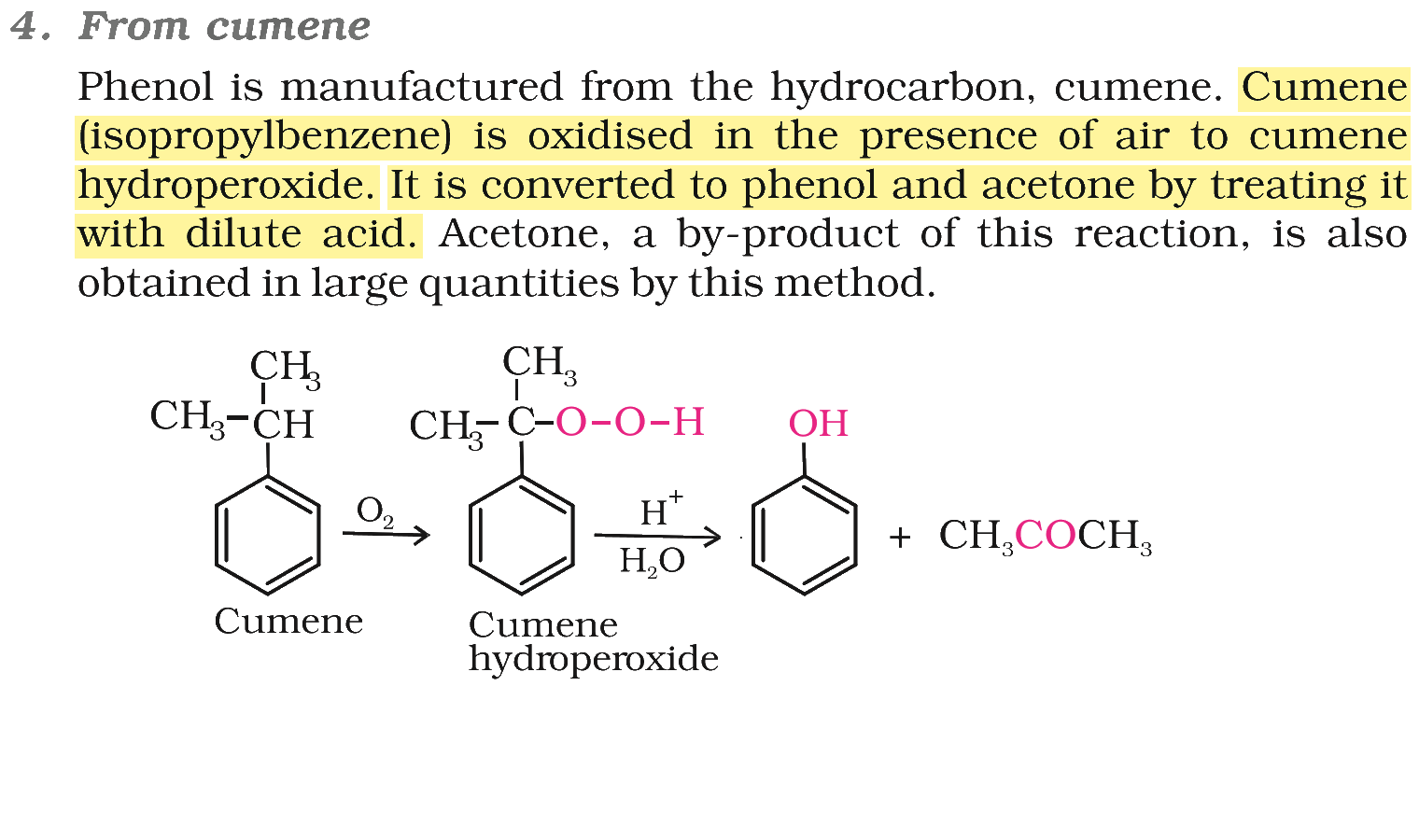
Compound D gives phenol (B) and a ketone used as an industrial solvent (C, acetone) on air oxidation. This is the cumene process, the main industrial method for making phenol. Cumene is isopropylbenzene, \( \ce{C6H5CH(CH3)2} \). Air oxidises it to cumene hydroperoxide, which dilute acid splits into phenol and acetone:
\( \displaystyle \ce{C6H5CH(CH3)2} \xrightarrow{\ce{O2}} \ce{C6H5C(CH3)2OOH} \xrightarrow{\ce{H+/H2O}} \ce{C6H5OH + CH3COCH3} \)
All four options are labelled “Cumene”, so the answer is decided by the structure. Only the structure in Option (4), a benzene ring carrying an isopropyl group (–\( \ce{CH(CH3)2} \)), is cumene.
Why the other options are incorrect
Option (1) — Incorrect. The structure is methylbenzene (toluene), not cumene.
Option (2) — Incorrect. The structure is propylbenzene (a straight –\( \ce{CH2CH2CH3} \) chain), an isomer of cumene with no tertiary benzylic hydrogen.
Option (3) — Incorrect. The structure is 3-phenylpentane (–\( \ce{CH(C2H5)2} \)); its oxidation would give pentan-3-one, not acetone.
NCERT (2026-27 edition):
From Cumene