Haloalkanes
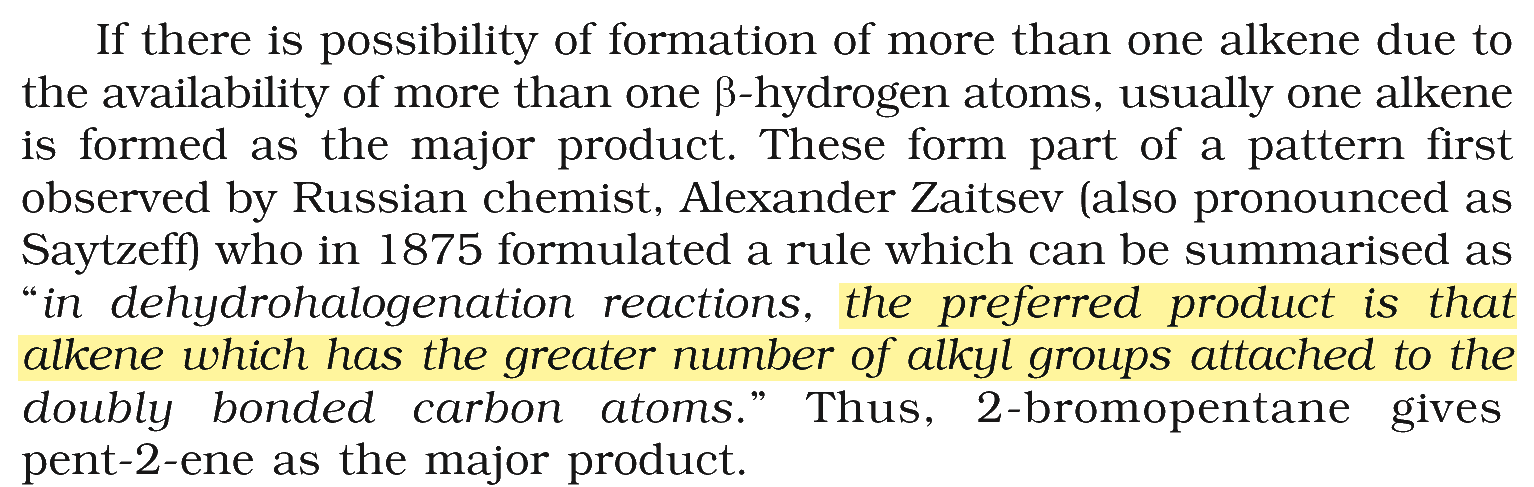
The alkyl halides (haloalkanes) are formed by replacement of hydrogen atom(s) in an aliphatic hydrocarbon by halogen atom(s). The homologous series of haloalkanes is represented by CnH2n+1X. They are further classified as primary, secondary or tertiary according to the nature of carbon to which halogen is attached. If halogen is attached to a primary carbon atom in an alkyl halide, the alkyl halide is called primary alkyl halide or 1° alkyl halide. Similarly, if halogen is attached to secondary or tertiary carbon atom, the alkyl halide is called secondary alkyl halide (2°) and tertiary (3°) alkyl halide, respectively. These are very slightly soluble in water but soluble in organic solvents. The photochemical bromination of alkanes gives a complex mixture of isomeric haloalkanes. The free radical monobromination of compound “A” (C5H12) gives some chiral and achiral 1°, 2° and 3° structural isomers. The boiling points of isomeric haloalkanes decrease with increase in branching. Most common reactions of alkyl halides are nucleophilic substitution reactions (SN1 and SN2), elimination and reactions with metals. When a chiral bromoalkane isomer of “A” is treated with magnesium metal in dry ether, it gives an organometallic compound which further reacts with water to give the hydrocarbon “B”, but if this isomer is heated with sodium metal in dry ether yields a different hydrocarbon “C”. The SN1 reaction occurs in two steps. In step I, the polarised C—Br bond undergoes slow cleavage to produce a carbocation and a bromide ion followed by attack of nucleophile (like hydroxide ion) in step-2. The haloalkane which gives more stable carbocation undergoes SN1 reaction with faster rate. In elimination reaction, the formation of an alkene as major and minor products by dehydrohalogenation of an alkyl halide is governed by Saytzeff rule which states that “the preferred product is that alkene which has the greater number of alkyl groups attached to the doubly bonded carbon atoms.”
Which of the following isomeric haloalkane gives 2-methylbut-2-ene as major product on dehydrohalogenation reaction?
Answer & explanation
Correct answer: option 3
The correct answer is Option (3) → 2-Bromo-2-methylbutane
In dehydrohalogenation, a haloalkane heated with alcoholic KOH loses HX: the halogen leaves from the α-carbon and a hydrogen from a neighbouring β-carbon, and a double bond forms between them. When there is more than one kind of β-hydrogen, Saytzeff rule decides the major product: the preferred alkene is the one with more alkyl groups on the doubly bonded carbons.
In 2-bromo-2-methylbutane, the β-hydrogens are on C-1 (\( \ce{CH3} \)) and on C-3 (\( \ce{CH2} \)):
\( \displaystyle \ce{CH3-C(CH3)(Br)-CH2-CH3 + KOH} \xrightarrow{\text{alcohol, }\Delta} \ce{CH3-C(CH3)=CH-CH3 + KBr + H2O}\ \text{(major)} \)
\( \displaystyle \text{and}\ \ce{CH2=C(CH3)-CH2-CH3}\ \text{(minor)} \)
Loss of H from C-3 gives 2-methylbut-2-ene, with three alkyl groups on the double bond, so it is the major product. Loss of H from C-1 gives 2-methylbut-1-ene (two alkyl groups), the minor product.
NCERT (2026-27 edition):
Elimination Reactions – …