The difference between firm's total revenue and total cost is called?
Answer & explanation
Correct answer: option 4
The correct answer is Option (4) → Profit
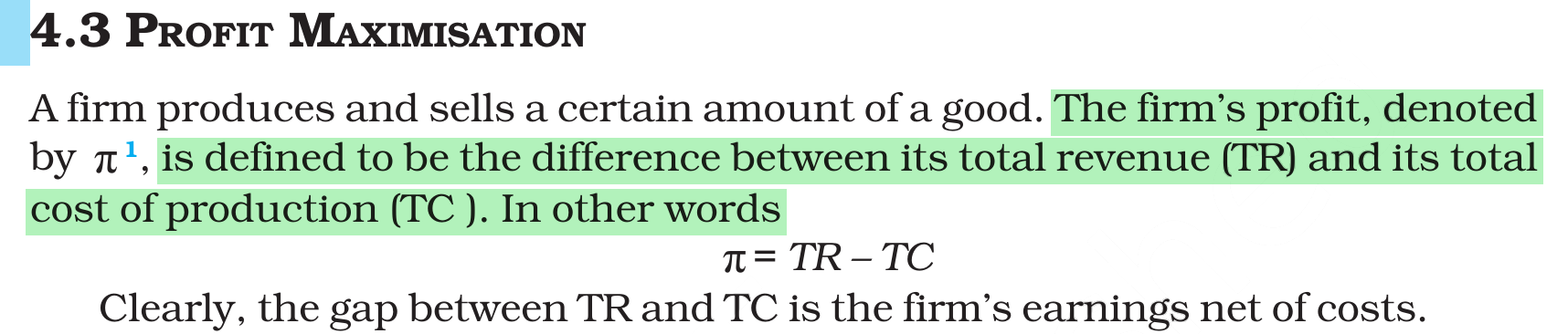
A firm sells its output and receives total revenue; to produce that output it pays for labour, land, capital and materials, its total cost. What is left of the revenue after the costs are paid is the firm’s profit, written π:
π = TR − TC
A firm chooses its output so as to make this gap as large as possible.
Why the other options are incorrect
Option (1) Output — Incorrect. Output is the quantity of the good the firm produces, a physical quantity and not a difference between revenue and cost.
Option (2) Production — Incorrect. Production is the process of turning inputs into output; it describes an activity, not a money surplus.
Option (3) Input — Incorrect. Inputs are the factors, such as labour and capital, used to produce the output; their cost is a part of TC, not what is left after TC is paid.
Note: A same/similar question was asked in CUET (UG) in the papers below.
| 2026 | 2025 | 2024 | 2023 | 2022 |
| 13-05 S1 | 13-05 S1* | – | – | – |
* A similar question.
NCERT: Introductory Microeconomics — Chapter 4: The Theory of the Firm under Perfect Competition (2025-26)
|