
CUETMOCK
  • Pricing
  • Mentors
Log inStart freeStart free mocks→

First test, then trust

Try a free CUET mock test.

Join 5,00,000+ students who rehearsed exam day on the exact NTA screen before sitting CUET. On the web and on Android.

Start free mocks →Get the Android app
CUETMOCK

India's #1 CUET Mock Test Platform. Original NCERT-based questions on the exact NTA exam screen — trusted by 5,00,000+ students since CUET 2022.

Get it onGoogle PlayScan to download the CUETMOCK app

Mock tests

  • CUET mock test series
  • Browse all papers
  • Commerce mocks
  • Humanities (Arts) mocks
  • Science mocks
  • Languages & GAT mocks
  • Free practice questions
  • Pricing

Resources

  • CUET exam guide
  • CUET syllabus
  • Universities accepting CUET
  • Expert blogs
  • News & notifications
  • Webinars & counselling
  • CUET score calculator
  • How we estimate your rank
  • FAQs

Company

  • About us
  • Our leadership & team
  • Our toppers
  • Mentors
  • For schools
  • Contact us
  • Terms
  • Privacy
  • Refund policy

Talk to us

+91 7696 6630 56info@cuetmock.comWhatsApp us

Our other platforms

  • JEE Mock — For IIT-JEE aspirants
  • NEET Mock — For NEET aspirants

Newsletter

Exam updates, study material and offers — no spam.

© 2026 NYC Ventures Pvt. Ltd.

701-702, Royal Business Park, Zirakpur, Punjab - 140603

  • Terms of use
  • Privacy policy
  • Refund policy
  • Contact us

iCUETMOCK is an independent preparation platform, not affiliated with the National Testing Agency (NTA). Always check exam details on the official NTA website.

  • Home
  • Mock tests
  • CUET guide
  • Pricing
  • Log in
Home/Practice questions/Maths. Section B1
Maths. Section B1Inverse Trigonometric Functions

A. The domain of sin^-1x is ≤ft[-(π)/2, (π)/2] B. The range of cosec^…

A. The domain of \(\sin^{-1}x\) is \(\left[-\displaystyle\frac{\pi}{2}, \frac{\pi}{2}\right]\)
B. The range of \(\mathrm{cosec}^{-1}x\) is \(\left[-\displaystyle\frac{\pi}{2}, \frac{\pi}{2}\right]-\{0\}\)
C. The domain of \(\sec^{-1}x\) is \([0, \pi]-\left\{\displaystyle\frac{\pi}{2}\right\}\)
D. The range of \(\cot^{-1}x\) is \((0, \pi)\)
E. The range of \(\tan^{-1}x\) is \(\left(-\displaystyle\frac{\pi}{2}, \frac{\pi}{2}\right)\)

Choose the correct answer from the options given below:

Answer & explanation+

Correct answer: option 3

The correct answer is Option (3) → B, D, E only

The domains and principal value ranges of the inverse trigonometric functions:

    \(\sin^{-1}x:\ \text{domain } [-1, 1],\ \text{range } \left[-\frac{\pi}{2}, \frac{\pi}{2}\right]\)

    \(\mathrm{cosec}^{-1}x:\ \text{domain } R - (-1, 1),\ \text{range } \left[-\frac{\pi}{2}, \frac{\pi}{2}\right] - \{0\}\)

    \(\sec^{-1}x:\ \text{domain } R - (-1, 1),\ \text{range } [0, \pi] - \left\{\frac{\pi}{2}\right\}\)

    \(\cot^{-1}x:\ \text{domain } R,\ \text{range } (0, \pi)\)

    \(\tan^{-1}x:\ \text{domain } R,\ \text{range } \left(-\frac{\pi}{2}, \frac{\pi}{2}\right)\)

So the domain of \(\sin^{-1}x\) is [−1, 1], the domain of \(\sec^{-1}x\) is R − (−1, 1), and the ranges of \(\mathrm{cosec}^{-1}x\), \(\cot^{-1}x\) and \(\tan^{-1}x\) are \(\left[-\frac{\pi}{2}, \frac{\pi}{2}\right] - \{0\}\), \((0, \pi)\) and \(\left(-\frac{\pi}{2}, \frac{\pi}{2}\right)\).

Checking the statements

(A) The domain of \(\sin^{-1}x\) is \(\left[-\frac{\pi}{2}, \frac{\pi}{2}\right]\) — Incorrect. The domain is [−1, 1]; \(\left[-\frac{\pi}{2}, \frac{\pi}{2}\right]\) is its range.

(B) The range of \(\mathrm{cosec}^{-1}x\) is \(\left[-\frac{\pi}{2}, \frac{\pi}{2}\right]-\{0\}\) — Correct. This is its principal value range.

(C) The domain of \(\sec^{-1}x\) is \([0, \pi]-\left\{\frac{\pi}{2}\right\}\) — Incorrect. That set is its range; the domain is R − (−1, 1).

(D) The range of \(\cot^{-1}x\) is \((0, \pi)\) — Correct. This is its principal value range.

(E) The range of \(\tan^{-1}x\) is \(\left(-\frac{\pi}{2}, \frac{\pi}{2}\right)\) — Correct. This is its principal value range.

NCERT (2026-27 edition):
Inverse Trigonometric Functions
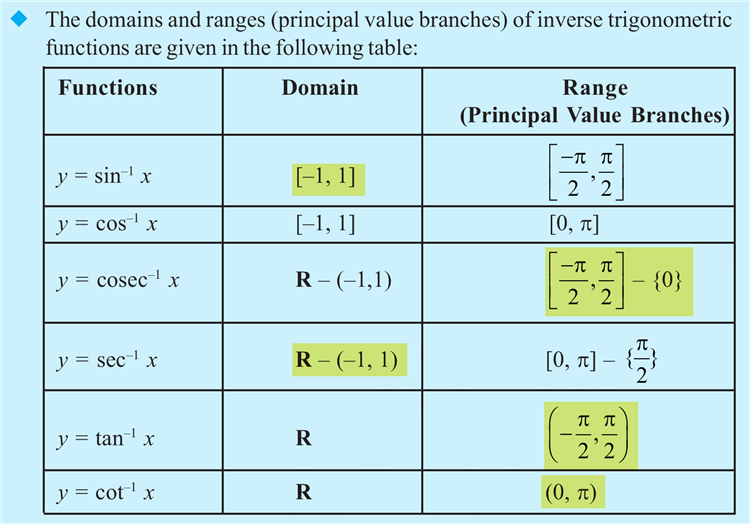
NCERT extract

Advertisement

Practise more on Inverse Trigonometric Functions

Chapter-wise mocks on the real NTA exam screen, with solutions and your rank. Your first mocks are free.

Start free mocks →

Advertisement

Next questions

  1. How many chords can be drawn through 5 points on a circle?General Aptitude Test · Quantitative Reasoning
  2. AB is a chord in a circle with center O. AB is produced to C such that BC is equal to the radius of the circle. C is joined to O and produc…General Aptitude Test · Quantitative Reasoning
  3. Four words have been given out of which three are alike in some manner, while one is different. Choose the odd one.General Aptitude Test · General Ability
  4. Which of the following interchange of signs and numbers would make the given equation correct? 12 ÷ 4 + 2 – 6 × 3 = 3 ÷ 12 + 6 × 2 – 4General Aptitude Test · Verbal Reasoning
  5. The length x of a rectangle is decreasing at the rate of 4 cm/minute and the width y is decreasing at the rate of 4 cm/minute. When x =2 cm…Maths. Section B1 · Applications of Derivatives
  6. Let R=(L_1,L_2): L_1 perp L_2 where L_1, L_2 ∈ L (set of straight line in a plane) , thenMaths. Section B1 · Relations and Functions
  7. If a convex lens made of a material of refractive index n_2 is immersed in a liquid of refractive index n_1 such that n_1 = n_2 , the incid…Physics · Ray Optics
  8. Which of the following periods is known as the period of steady population growth in India?Geography · India-People and Economy: Population-Distribution,Density, Growth and Composition
  9. AD is an altitude of an isosceles triangle ABC in which AB = AC. Which of the following is true?General Aptitude Test · Quantitative Reasoning
  10. Read the given sentence carefully. Choose the option that best replaces the underlined phrase:The proliferation of social media platforms h…English · One Word