
Read the information given below.
It is useful to design lenses of derived focal length using surface of suitable radii of curvature. Lens maker formula helps in finding various unknowns and is widely applied.
If a convex lens made of a material of refractive index \( n_2 \) is immersed in a liquid of refractive index \( n_1 \) such that \( n_1 = n_2 \), the incident beam of light will emerge as shown
Answer & explanation
Correct answer: option 4
The correct answer is Option (4)
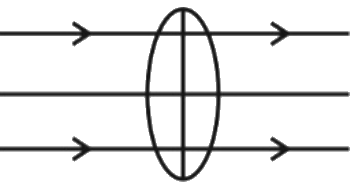
For a lens of refractive index \( n_2 \) placed in a medium of refractive index \( n_1 \), the lens maker's formula is
\( \displaystyle \frac{1}{f} = \left(\frac{n_2}{n_1} - 1\right)\left(\frac{1}{R_1} - \frac{1}{R_2}\right) \)
Putting \( n_1 = n_2 \):
\( \displaystyle \frac{1}{f} = (1 - 1)\left(\frac{1}{R_1} - \frac{1}{R_2}\right) = 0 \;\Rightarrow\; f = \infty \)
With equal refractive indices there is no refraction at either surface; the lens behaves like a part of the liquid. The parallel beam goes straight through undeviated, which is the figure of Option (4).
Why the other options are incorrect
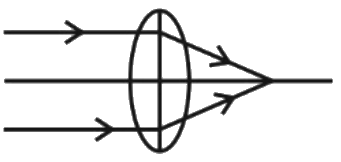
Option (1) — Incorrect. The beam converges, which happens only when \( n_2 \gt n_1 \) (a convex lens in a less dense medium).
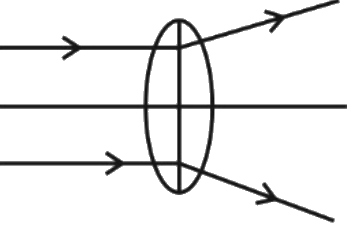
Option (2) — Incorrect. The beam diverges, which happens only when \( n_2 \lt n_1 \) (a convex lens in a denser medium).
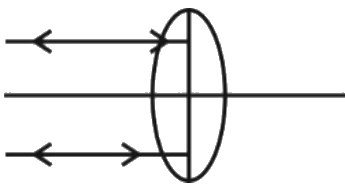
Option (3) — Incorrect. The beam is sent back, as if reflected; a lens with the same refractive index as the liquid neither reflects nor bends the light.
NCERT (2026-27):
Refraction by a Lens – “… The refractive index of the liquid must be equal to 1.47 in order to make the lens disappear. This means n1 = n2. This gives 1/f = 0 or f → ∞. The lens in the liquid will act like a plane sheet of glass.”