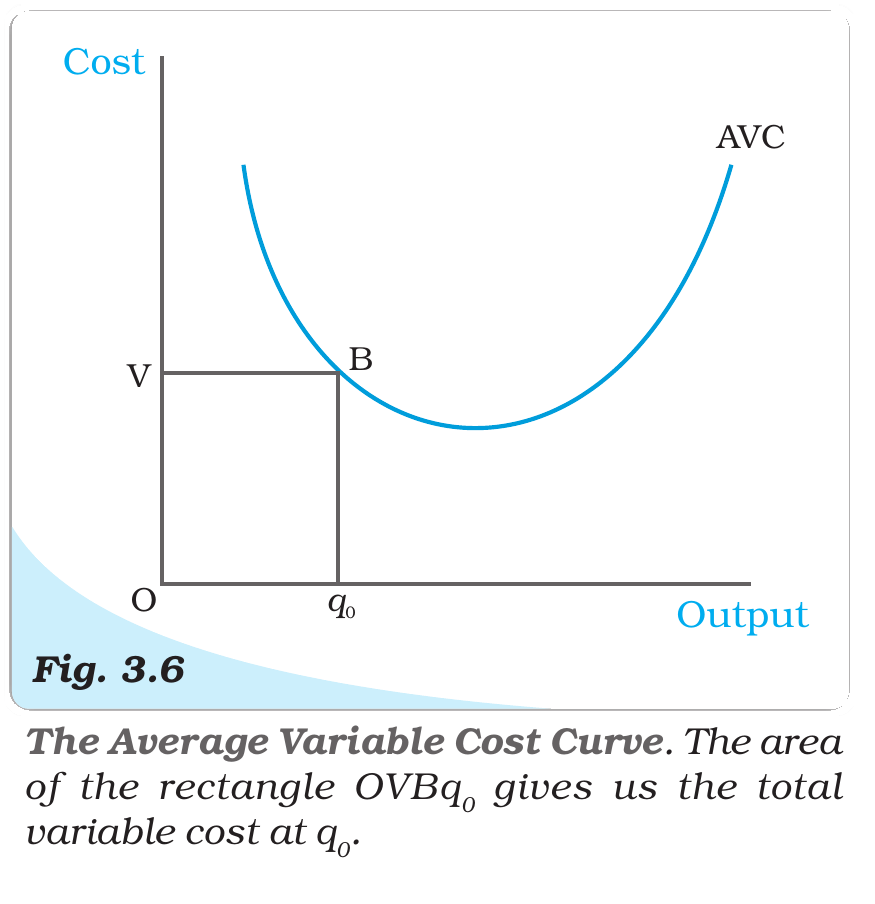
In the short run, Average Variable Cost curve is a U-shaped cost curve because of----------------.
Answer & explanation
Correct answer: option 2
The correct answer is Option (2) → Law of Variable Proportions
In the short run a firm has a fixed input, such as its plant, and can raise output only by adding more of a variable input, such as labour. Its average variable cost (AVC) is the variable cost per unit of output, TVC ÷ q, and it moves with what each added worker contributes:
At first each added worker adds more to output than the one before, so every extra unit of output needs less labour; marginal cost falls, and AVC falls with it.
After a point the fixed plant gets crowded and each added worker adds less, so every extra unit of output needs more labour; marginal cost rises, and once it is above AVC, AVC rises too.
This rise and then fall of the marginal product is the Law of Variable Proportions, and the fall and then rise of cost that it causes gives the AVC curve its U shape.
Why the other options are incorrect
Option (1) Law of Diminishing Marginal Utility — Incorrect. This belongs to consumer behaviour: it describes the satisfaction from consuming more units of a good, and has no bearing on a firm’s costs.
Option (3) Returns to Scale — Incorrect. Returns to scale describe what happens when all inputs are changed together, which is possible only in the long run.
Option (4) Law of Demand — Incorrect. The law of demand links the price of a good to the quantity buyers want, and does not shape a cost curve.
NCERT (2025-26): “Shapes of the Short Run Cost Curves … Let us now look at the SMC curve. Marginal cost is the additional cost that a firm incurs to produce one extra unit of output. According to the law of variable proportions, initially, the marginal product of a factor increases as employment increases, and then after a certain point, it decreases. This means initially to produce every extra unit of output, the requirement of the factor becomes less and less, and then after a certain point, it becomes greater and greater. As a result, with the factor price given, initially the SMC falls, and then after a certain point, it rises. SMC curve is, therefore, ‘U’-shaped.… …Now, what does the AVC curve look like? For the first unit of output, it is easy to check that SMC and AVC are the same. So both SMC and AVC curves start from the same point. Then, as output increases, SMC falls. AVC being the average of marginal costs, also falls, but falls less than SMC. Then, after a point, SMC starts rising. AVC, however, continues to fall as long as the value of SMC remains less than the prevailing value of AVC. Once the SMC has risen sufficiently, its value becomes greater than the value of AVC. The AVC then starts rising. The AVC curve is therefore ‘U’-shaped.…”
|