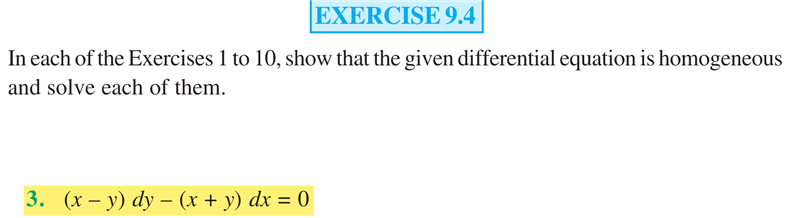
The general solution of the differential equation \( (y-x)dy+(x+y)dx=0 \) is: (where C is arbitrary constant)
Answer & explanation
Correct answer: option 1
The correct answer is Option (1) → \( \tan^{-1}\displaystyle\frac{y}{x}=\log_{e}\left(\sqrt{x^{2}+y^{2}}\right)+\mathrm{C} \)
From the given equation,
\( \displaystyle \frac{dy}{dx}=-\frac{x+y}{y-x}=\frac{x+y}{x-y} \)
This is homogeneous, so put \( y=vx \), \( \frac{dy}{dx}=v+x\frac{dv}{dx} \):
\( \displaystyle v+x\frac{dv}{dx}=\frac{1+v}{1-v} \)
\( \displaystyle x\frac{dv}{dx}=\frac{1+v}{1-v}-v \)
\( \displaystyle =\frac{1+v^{2}}{1-v} \)
Separating the variables:
\( \displaystyle \frac{1-v}{1+v^{2}}\,dv=\frac{dx}{x} \)
\( \displaystyle \int\frac{dv}{1+v^{2}}-\frac{1}{2}\int\frac{2v}{1+v^{2}}\,dv=\int\frac{dx}{x} \)
\( \displaystyle \tan^{-1}v-\frac{1}{2}\log_{e}(1+v^{2})=\log_{e}|x|+C \)
Putting back \( v=\frac{y}{x} \):
\( \displaystyle \tan^{-1}\frac{y}{x}=\frac{1}{2}\log_{e}\left(\frac{x^{2}+y^{2}}{x^{2}}\right)+\log_{e}|x|+C \)
\( \displaystyle =\frac{1}{2}\log_{e}(x^{2}+y^{2})+C \)
\( \displaystyle \tan^{-1}\frac{y}{x}=\log_{e}\left(\sqrt{x^{2}+y^{2}}\right)+C \)
Shortcut: Regroup the terms of the equation:
\( \displaystyle (x\,dx+y\,dy)+(y\,dx-x\,dy)=0 \)
\( \displaystyle x\,dx+y\,dy=x\,dy-y\,dx \)
Dividing by \( x^{2}+y^{2} \), both sides are exact differentials:
\( \displaystyle \frac{x\,dx+y\,dy}{x^{2}+y^{2}}=d\left(\log_{e}\sqrt{x^{2}+y^{2}}\right) \)
\( \displaystyle \frac{x\,dy-y\,dx}{x^{2}+y^{2}}=d\left(\tan^{-1}\frac{y}{x}\right) \)
Integrating gives Option (1) at once.
NCERT (2026-27 edition):
Homogeneous Differential Equations