Conversion of carboxylic acid to hydrocarbon is carried out using
Answer & explanation
Correct answer: option 3
The correct answer is Option (3) → NaOH and CaO
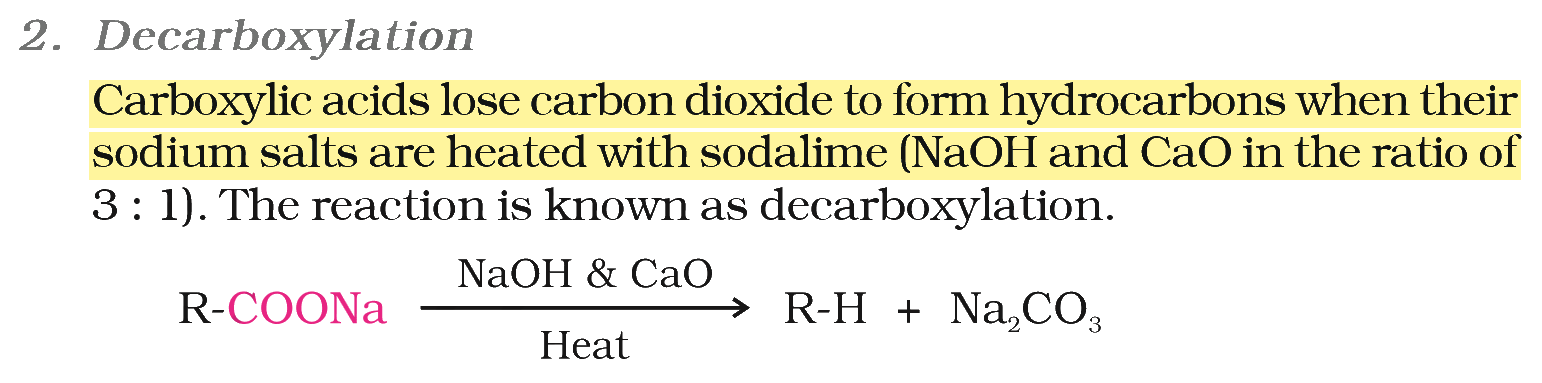
Removing the –COOH group of a carboxylic acid as \( \ce{CO2} \) is called decarboxylation. The acid is first converted into its sodium salt, which is then heated with soda-lime (NaOH and CaO in the ratio 3 : 1). The carboxyl group is replaced by a hydrogen atom, so the hydrocarbon formed has one carbon atom fewer than the acid:
\( \displaystyle \ce{R-COONa} \xrightarrow[\text{heat}]{\ce{NaOH + CaO}} \ce{R-H + Na2CO3} \)
For example, sodium ethanoate gives methane:
\( \displaystyle \ce{CH3COONa} \xrightarrow[\text{heat}]{\ce{NaOH + CaO}} \ce{CH4 + Na2CO3} \)
So the conversion of a carboxylic acid to a hydrocarbon is carried out with NaOH and CaO.
Why the other options are incorrect
Option (1) KMnO4 — Incorrect. It is an oxidising agent. It is used to make carboxylic acids (for example from alkylbenzenes), not to remove the carboxyl group.
Option (2) LiAlH4 and ether — Incorrect. It reduces a carboxylic acid to a primary alcohol, \( \ce{R-CH2OH} \), keeping every carbon atom.
Option (4) B2H6 (Diborane) — Incorrect. Diborane also reduces the –COOH group to –\( \ce{CH2OH} \), giving a primary alcohol.
NCERT (2026-27 edition):
Decarboxylation