
CUETMOCK
  • Pricing
  • Mentors
Log inStart freeStart free mocks→

First test, then trust

Try a free CUET mock test.

Join 5,00,000+ students who rehearsed exam day on the exact NTA screen before sitting CUET. On the web and on Android.

Start free mocks →Get the Android app
CUETMOCK

India's #1 CUET Mock Test Platform. Original NCERT-based questions on the exact NTA exam screen — trusted by 5,00,000+ students since CUET 2022.

Get it onGoogle PlayScan to download the CUETMOCK app

Mock tests

  • CUET mock test series
  • Commerce mocks
  • Humanities (Arts) mocks
  • Science mocks
  • Languages & GAT mocks
  • Free practice questions
  • Pricing

Resources

  • CUET exam guide
  • CUET syllabus
  • Universities accepting CUET
  • Expert blogs
  • News & notifications
  • Webinars & counselling
  • CUET score calculator
  • How we estimate your rank
  • FAQs

Company

  • About us
  • Our leadership & team
  • Our toppers
  • Mentors
  • For schools
  • Contact us
  • Terms
  • Privacy
  • Refund policy

Talk to us

+91 7696 6630 56info@cuetmock.comWhatsApp us

Our other platforms

  • JEE Mock — For IIT-JEE aspirants
  • NEET Mock — For NEET aspirants

Newsletter

Exam updates, study material and offers — no spam.

© 2026 NYC Ventures Pvt. Ltd.

701-702, Royal Business Park, Zirakpur, Punjab - 140603

  • Terms of use
  • Privacy policy
  • Refund policy
  • Contact us

iCUETMOCK is an independent preparation platform, not affiliated with the National Testing Agency (NTA). Always check exam details on the official NTA website.

  • Home
  • Mock tests
  • CUET guide
  • Pricing
  • Log in
Home/Practice questions/Chemistry
ChemistryOrganic: Aldehydes, Ketones and Carboxylic Acids

Which of the following carboxylic acid has the highest pKa value?

Carboxylic Acids: Types of Reactions

Carboxylic acid exhibits a number of reactions depending on the involvement of a specific part of the -COOH group. It mainly includes nucleophilic acyl substitution reaction, in which a hydroxy group of -COOH is replaced by another nucleophile, and the acidic behavior of carboxylic acids, which is due to the cleavage of O-H bond in -COOH group. The former reaction leads to the conversion of carboxylic acid into a variety of different derivatives/categories of organic compounds, whereas the latter converts it into salts which find applications in many industries, like soap and detergent synthesis and pharmaceutical industries. Other important types of chemical reactions involve reduction of -COOH group, decarboxylation, electrolysis and substitution reactions in the hydrocarbon part at α-carbon atom.

Which of the following carboxylic acid has the highest pKa value?

Answer & explanation+

Correct answer: option 2

The correct answer is Option (2) → 4-methoxybenzoic acid

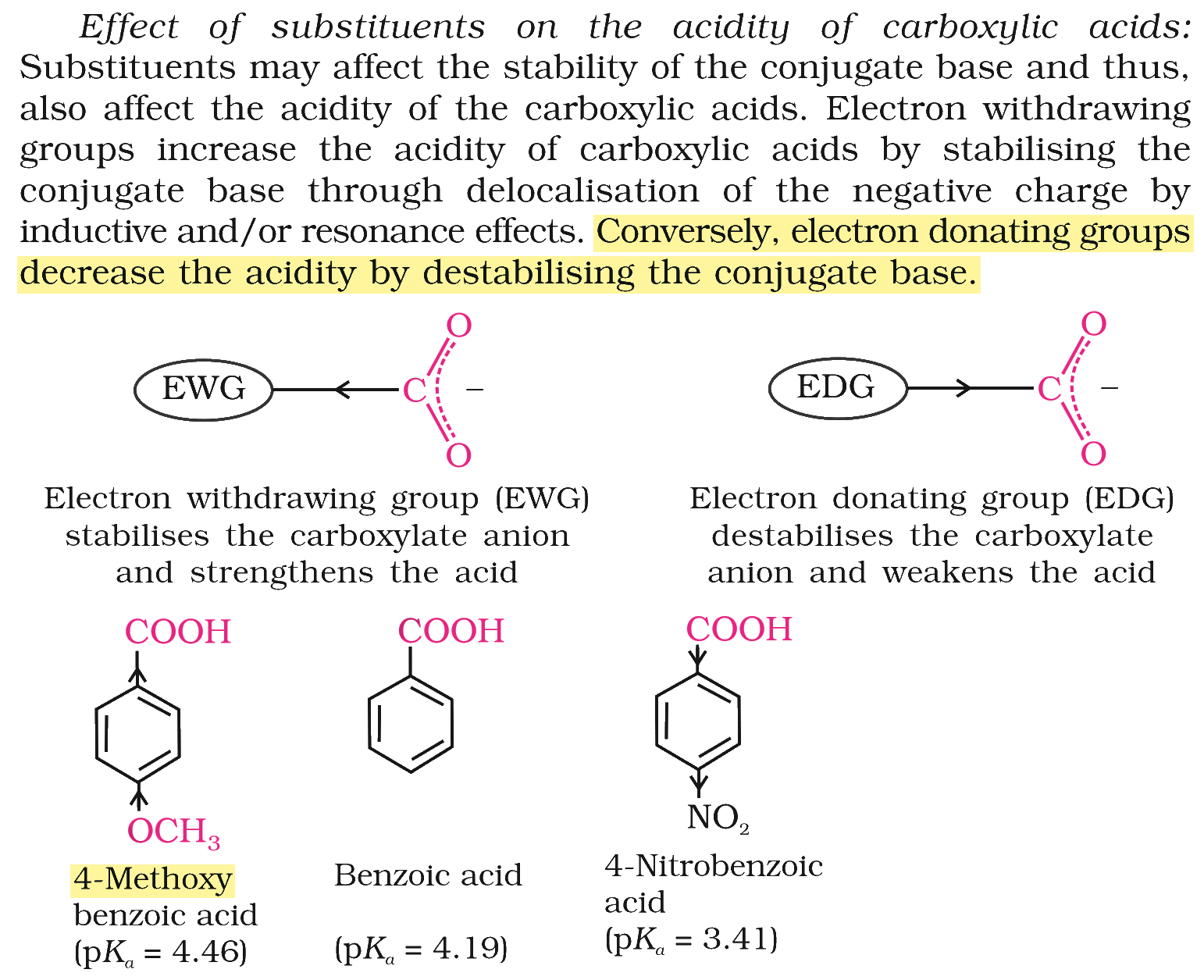
pKa = −log Ka, so a higher pKa means a weaker acid. The strength of a substituted benzoic acid depends on how the substituent affects the carboxylate ion formed on losing \( \ce{H^{+}} \):

  • Electron withdrawing groups (–\( \ce{NO2} \), –CN) spread out the negative charge and stabilise the carboxylate ion. The acid becomes stronger and its pKa lower.

  • Electron donating groups (–\( \ce{OCH3} \), which donates by resonance from the para position) push more electron density onto the carboxylate ion and destabilise it. The acid becomes weaker and its pKa higher.

The pKa values of the four acids are:

    \( \displaystyle \text{4-nitrobenzoic acid }(3.41) < \text{4-cyanobenzoic acid }(3.55) \)

    \( \displaystyle < \text{benzoic acid }(4.19) < \text{4-methoxybenzoic acid }(4.46) \)

So the acid with the highest pKa, the weakest of the four, is 4-methoxybenzoic acid.

Why the other options are incorrect

  • Option (1) benzoic acid — Incorrect. It has no electron donating group, so it is stronger than 4-methoxybenzoic acid and has a lower pKa (4.19).

  • Option (3) 4-cyanobenzoic acid — Incorrect. –CN withdraws electrons, which increases acidity and lowers pKa (3.55).

  • Option (4) 4-nitrobenzoic acid — Incorrect. –\( \ce{NO2} \) is the strongest electron withdrawing group here, so this is the strongest acid, with the lowest pKa (3.41).

NCERT (2026-27 edition):
Effect of Substituents on the Acidity of Carboxylic Acids
Textbook extract

Advertisement

Practise more on Organic: Aldehydes, Ketones and Carboxylic Acids

Chapter-wise mocks on the real NTA exam screen, with solutions and your rank. Your first mocks are free.

Start free mocks →

Advertisement

Next questions

  1. Which statements are correct from the following regarding Partnership?A. When a partner dies, the combined share of the continuing partner'…Accountancy Part A · Reconstitution of Partnership Firm: Retirement and Death
  2. Rearrange the following parts in the correct sequence to form a coherent and meaningful sentence:A. every now and then someB. of administra…English · Arrange in Meaningful Sequence
  3. Let a function f:R→R defined as f(x)=x-[x] , (where R is set of real numbers & [.] denotes greatest integer function). Then the function:Maths. Section B1 · Relations and Functions
  4. Select the Correct statement from the following:Chemistry · Inorganic: D and F Block Elements
  5. Conversion of carboxylic acid to hydrocarbon is carried out usingChemistry · Organic: Aldehydes, Ketones and Carboxylic Acids
  6. If the function f(x)= […] is continuous at x=5 , then the value of k is:Maths. Section B1 · Continuity and Differentiability
  7. Which of the following historical events are correctly matched with their time period?A. Accession of Chandragupta Maurya - 321 BCEB. Reign…General Aptitude Test · General Knowledge
  8. Which of the following is a principle of Shallow Ecology?Environmental Studies
  9. Where does Eco R I cut the DNA when the sequence GAATTC is present in the DNA?Biology · Biotechnology -Principles and Processes
  10. Which political ideas associated with the artist are used in folk themes?Fine Arts · The Modern Indian Art