
As per the graph given below:
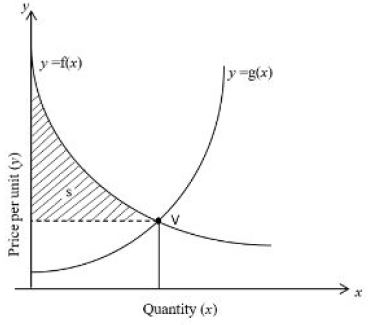
Match List-I with List-II
|
List-I (Function/Area/point) |
List-II (Representation) |
|
(A) Consumers Surplus |
(I) $y=g(x)$ |
|
(B) Supply function |
(II) $v$ |
|
(C) Demand function |
(III) $s$ |
|
(D) Equilibrium point |
(IV) $y=f(x)$ |
Choose the correct answer from the options given below:
Answer & explanation
Correct answer: option 3
The correct answer is Option (3) → (A)-(III), (B)-(I), (C)-(IV), (D)-(II)
(A) Consumers Surplus → $s$
Consumer surplus is the difference between what a consumer is willing to pay (demand curve) and what they actually pay (market price). It is represented as $s$, i.e., the surplus enjoyed by consumers.
(B) Supply function → $y = g(x)$
The supply function shows the relationship between quantity supplied and price. It is usually written as $y = g(x)$, where $y$ is quantity supplied and $x$ is price.
(C) Demand function → $y = f(x)$
The demand function shows the relationship between quantity demanded and price. It is represented as $y = f(x)$, where $y$ is quantity demanded and $x$ is price.
(D) Equilibrium point → $v$
The equilibrium point occurs where demand equals supply, i.e., $f(x) = g(x)$. At this point, both buyers and sellers are satisfied. It is represented by $v$ in the list.