
Aldehydes and ketones are two important classes of organic compounds which are widely used in the synthesis of a variety of other organic compounds. Due to the polarity of the carbonyl group, they undergo nucleophilic addition reactions. Broadly speaking, these addition reactions are of two types- one in which simply the addition of the nucleophilic reagent occurs across \(>C=O\) bond and the other in which addition is followed by the elimination of a molecule of water. A number of ammonia derivatives such as hydroxylamine, hydrazine, phenylhydrazine, 2,4-dinitrophenylhydrazine, and semicarbazide belong to the second category of reactions. These derivatives are used for the identification and characterization of aldehydes/ketones. Both types of nucleophilic addition reactions are influenced by steric and electronic factors. In general, aliphatic aldehydes are more reactive than aromatic aldehydes. The aliphatic aldehydes reduce both Fehling's solution and Tollen's reagent but aromatic aldehydes reduce only Tollen's reagent. Like aldehydes, aromatic ketones are less reactive than aliphatic ketones towards nucleophilic addition reactions.
Phenols and carboxylic acids are acidic in nature. Both dissolve in \(NaOH\) solution and turn blue litmus red. However carboxylic acids are much stronger acids than phenols and decompose \(NaHCO_3\) with the evolution of \(CO_2\) but phenols do not. Both electron-donating and electron-withdrawing substituents influence the acid strength of aliphatic as well as aromatic acids. Unlike all other aliphatic acids, formic acid has reducing properties and also does not show reactions of the alkyl group.
Which of the following statement/s is/are correct?
A. Aldehydes give positive test with Tollen's reagent
B. Ketones give positive test with Fehling's solution
C. Ketones do not react with Fehling's solution
D. Aldehydes with Schiff's reagent restore pink colour
E. Ketones with Schiff's reagent restore pink colour
Choose the correct answer from the options given below:
Answer & explanation
Correct answer: option 3
The correct answer is Option (3) → A, C, D only
Aldehydes are easily oxidised, so they reduce mild oxidising agents such as Tollens’ reagent and Fehling’s solution. Ketones are oxidised only by strong oxidising agents under vigorous conditions, so these tests tell aldehydes from ketones.
(A) Aldehydes give positive test with Tollen’s reagent — True. Warming an aldehyde with ammoniacal silver nitrate gives a silver mirror:
\( \ce{RCHO + 2[Ag(NH3)2]+ + 3OH- -> RCOO- + 2Ag + 2H2O + 4NH3} \)
(B) Ketones give positive test with Fehling’s solution — False. Ketones are not oxidised by mild oxidising agents, so they do not reduce Fehling’s solution.
(C) Ketones do not react with Fehling’s solution — True. No reddish brown precipitate of \( \ce{Cu2O} \) forms with ketones; aldehydes give it:
\( \ce{RCHO + 2Cu^2+ + 5OH- -> RCOO- + Cu2O + 3H2O} \)
(D) Aldehydes with Schiff’s reagent restore pink colour — True. Schiff’s reagent (rosaniline decolourised by \( \ce{SO2} \)) regains its pink-magenta colour with aldehydes; this is the Schiff’s test for the aldehyde group.
(E) Ketones with Schiff’s reagent restore pink colour — False. Ketones in general do not give Schiff’s test.
NCERT (2026-27 edition):
Oxidation – …
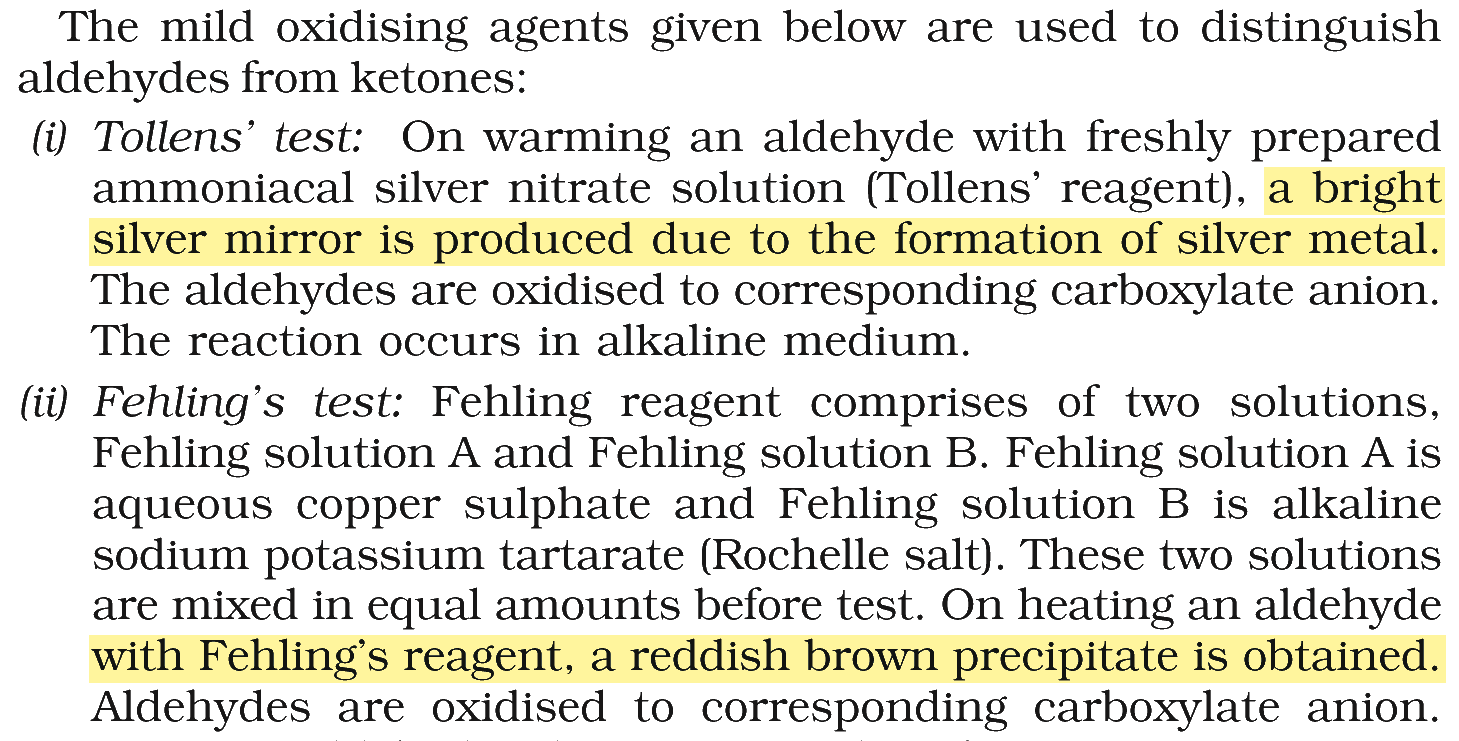
Cyclic Structure of Glucose – “… 1. Despite having the aldehyde group, glucose does not give Schiff’s test and it does not form the hydrogensulphite addition product with NaHSO3.”
Note: The same/similar question has been asked in different years by NTA as per the details given below:
| 2026 | 2025 | 2024 | 2023 | 2022 |
|---|---|---|---|---|
| – | – | – | 02-06 S3 31-05 S1 | – |