
Figure given below shows variation of photocurrent with anode potential for different intensities of incident radiation. Some of the results obtained from the experiments are described below on the basis of the graph. Identify the correct results:
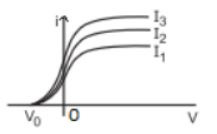
(A) The photoelectric current is higher for higher intensity of the incident radiation.
(B) The negative potential required to decrease the photocurrent at different intensities to zero is different.
(C) If the positive potential of the anode is increased beyond a certain value, the photocurrent does not increase for a given intensity.
(D) If the potential applied at the anode is zero, then the photocurrent is lower than the maximum value of current for the given intensity.
Choose the correct answer from the options given below:
Answer & explanation
Correct answer: option 3
The correct answer is Option (3) → (A), (C) and (D) only
The graph is for one frequency at three intensities \( I_1 \lt I_2 \lt I_3 \): intensity fixes the number of photoelectrons per second, frequency fixes their maximum kinetic energy.
(A) The photoelectric current is higher for higher intensity of the incident radiation. — Correct. The \( I_3 \) curve lies highest: more photons per second release more electrons.
(B) The negative potential required to decrease the photocurrent at different intensities to zero is different. — Incorrect. All curves reach zero at the same \( V_0 \); the stopping potential (\( eV_0 = K_{\max} \)) depends on the frequency, not on the intensity.
(C) If the positive potential of the anode is increased beyond a certain value, the photocurrent does not increase for a given intensity. — Correct. Once every emitted electron reaches the anode, the current reaches its saturation value.
(D) If the potential applied at the anode is zero, then the photocurrent is lower than the maximum value of current for the given intensity. — Correct. At zero potential some electrons still reach the anode, but each curve at \( V = 0 \) is below its saturation level.
NCERT (2026-27):
Effect of Potential on Photoelectric Current – “… If we increase the accelerating potential of plate A further, the photocurrent does not increase. This maximum value of the photoelectric current is called saturation current.”
Effect of Potential on Photoelectric Current – “… We can now repeat this experiment with incident radiation of the same frequency but of higher intensity I2 and I3 (I3 > I2 > I1). We note that the saturation currents are now found to be at higher values. … Thus, for a given frequency of the incident radiation, the stopping potential is independent of its intensity.”