
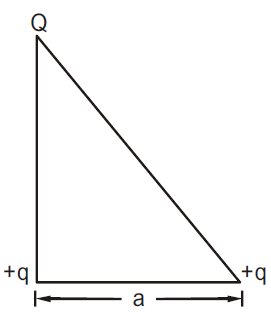
Three charges Q, +q and +q are placed at the vertices of an isosceles right-angled triangle as shown. The net electrostatic energy of the configuration is zero if Q is equal to
Answer & explanation
Correct answer: option 2
The correct answer is Option (2) → \( \displaystyle\frac{-2q}{2+\sqrt{2}} \)
The electrostatic potential energy of a system of point charges is the sum of \( q_iq_j/4\pi\varepsilon_0 r_{ij} \) over every pair of charges.
From the figure, the right angle is at the lower-left +q, and the two equal sides are each \( a \). So the distances are:
between the two charges +q: \( a \)
between Q and the lower-left +q: \( a \)
between Q and the lower-right +q (the hypotenuse): \( \sqrt{2}\,a \)
Setting the total energy to zero:
\( \displaystyle \frac{1}{4\pi\varepsilon_0}\left(\frac{q^{2}}{a}+\frac{Qq}{a}+\frac{Qq}{\sqrt{2}\,a}\right)=0 \)
\( \displaystyle q+Q\left(1+\frac{1}{\sqrt{2}}\right)=0 \)
\( \begin{aligned} Q &= -\frac{q}{1+1/\sqrt{2}} \\ &= -\frac{\sqrt{2}\,q}{\sqrt{2}+1} \\ &= \frac{-2q}{2+\sqrt{2}} \end{aligned} \)