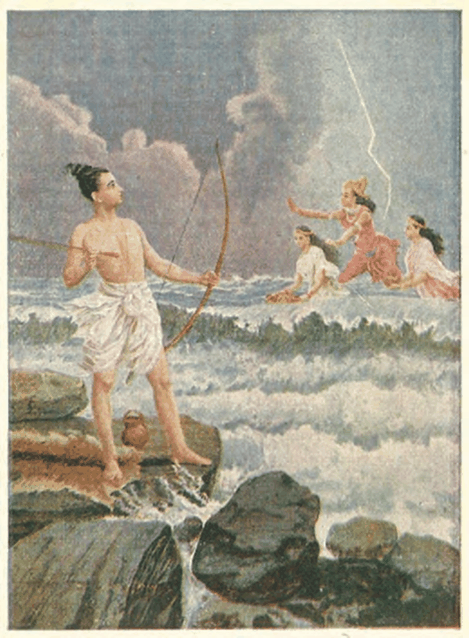
Raja Ravi Varma painted Puranic (ancient mythological) themes. Given below are two statements: one is labelled as Assertion (A) and the other is labelled as Reason (R).
Assertion (A): Paintings like Rama Vanquishing the Pride of the Ocean depict a scene from an epic, painted in the midst of a dramatic action.
Reason (R): Ravi Varma was one of the first Indian painters to master the art of lithographic reproduction for mythological subjects.
In the light of the above statements, choose the correct answer from the options given below:
Answer & explanation
Correct answer: option 2
The correct answer is Option (2) → Both (A) and (R) are true but (R) is NOT the correct explanation of (A).
Assertion (A): Paintings like Rama Vanquishing the Pride of the Ocean depict a scene from an epic, painted in the midst of a dramatic action. — True. These paintings show a historic moment or a scene from an epic or a classical text, in the midst of a dramatic action.
Reason (R): Ravi Varma was one of the first Indian painters to master the art of lithographic reproduction for mythological subjects. — True. He was among the first to use oil paint and master lithographic reproduction.
Why R does not explain A? Lithographic reproduction is a way of printing copies of a painting. It tells how his works were reproduced, not why they show an epic scene at its most dramatic point. The correct reason for A: such paintings aim to be noble, momentous and emotional.
NCERT (2026-27): “Rama Vanquishing the Pride of the Ocean This is a Puranic (ancient mythological stories) theme painted by Raja Ravi Varma. He was one of the first Indian painters to use oil paint and master the art of lithographic reproduction for mythological subject. These paintings are, generally, large ones, depicting a historic moment or scene from an epic or a classical text, painted in the midst of a dramatic action. It is intended to be noble, momentous and emotional.”
|