Read the following Passage carefully and give the answer :
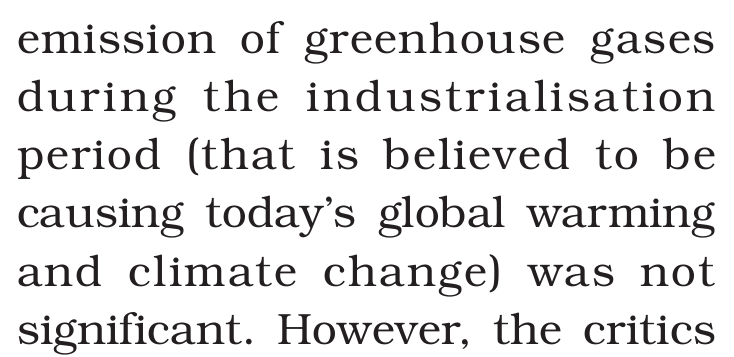
India has faced traditional (military) and non-traditional threats to its security that have emerged from within as well as outside its borders. Its security strategy has four broad components- The first component was strengthening its military capabilities, and the second component of India’s security strategy has been to strengthen international norms and international institutions to protect its security interests. The third component of the Indian security strategy is geared towards meeting security challenges within the country, and fourth, there has been an attempt in India to develop its economy in a way that the vast mass of citizens are lifted out of poverty and misery and huge economic inequalities, which have been used in varying combinations from time to time. India led the Non-Aligned movement as a challenge to the dominance of the two superpowers. It also championed the cause of establishing NIEO as a means of attaining economic development and political independence. India has also strengthened the cause of environmental security by signing the Kyoto Protocol to address the issue of greenhouse gas emissions and Global Warming.
When did India sign the ‘Kyoto Protocol’?
Answer & explanation
Correct answer: option 3
The correct answer is Option (3) → 2002
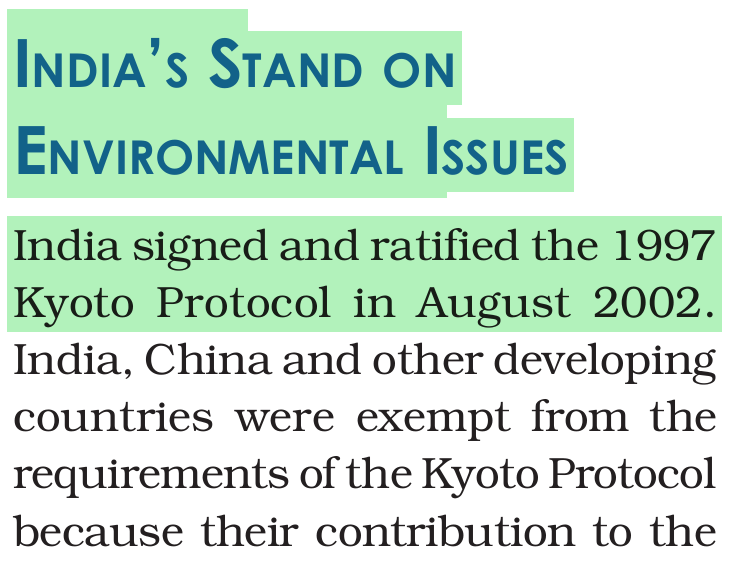
India signed and ratified the 1997 Kyoto Protocol in August 2002.
Note: A same/similar question was asked in CUET (UG) in the papers below.
| 2026 | 2025 | 2024 | 2023 | 2022 |
| 15-05 S1* | 16-05 S1* 29-05 S1* 03-06 S2* | – | 24-05 S1* 28-05 S1* 30-05 S2 02-06 S1* 09-06 S3* 12-06 S2* 12-06 S3* 18-06 S1* 19-06 S3* | – |
* A similar question.
NCERT (2026-27): Contemporary World Politics — Chapter 6: Environment and Natural Resources
|