
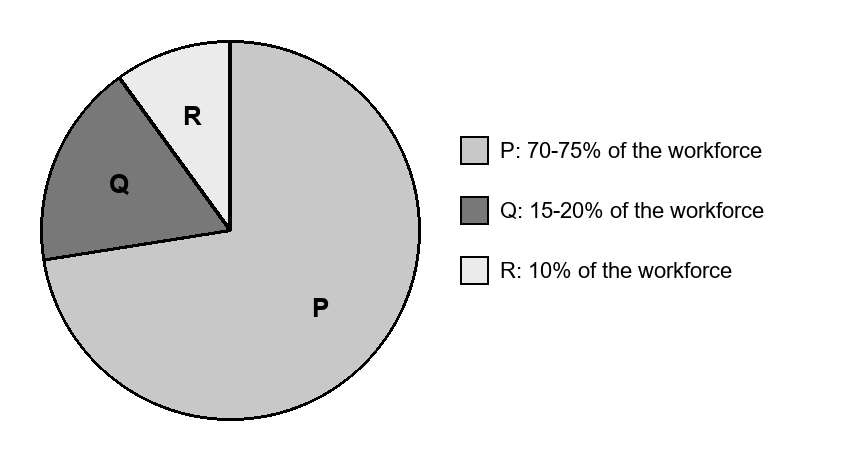
The pie chart shows the occupational structure of India during the colonial period. The three sectors are marked P, Q and R.
Which of the following is correct?
Answer & explanation
Correct answer: option 3
The correct answer is Option (3) → P is agriculture and R is manufacturing; the share of P fell in parts of the Madras Presidency, Bombay and Bengal.
Two facts decide this. First, the shares: agriculture had 70-75 per cent of the workforce, services 15-20 per cent and manufacturing only 10 per cent. So P is agriculture, Q is services and R is manufacturing.
Second, the regions. Agriculture’s share fell in parts of the Madras Presidency, Bombay and Bengal, where manufacturing and services grew. It rose in Orissa, Rajasthan and Punjab.
Option (1) P is agriculture and R is services; the share of P fell in parts of the Madras Presidency, Bombay and Bengal. — Incorrect. R is the smallest share, 10 per cent, so it is manufacturing, not services.
Option (2) P is agriculture and R is manufacturing; the share of P fell in Orissa, Rajasthan and Punjab. — Incorrect. In these states the share of agriculture rose.
Option (3) P is agriculture and R is manufacturing; the share of P fell in parts of the Madras Presidency, Bombay and Bengal. — Correct. Both the sectors and the regions fit.
Option (4) P is agriculture and Q is manufacturing; the share of P rose in parts of the Madras Presidency, Bombay and Bengal. — Incorrect. Q is services, and the share of agriculture fell in these regions.
NCERT (2026-27): “1.7 Occupational Structure During the colonial period, the occupational structure of India, i.e., distribution of working persons across different industries and sectors, showed little sign of change. The agricultural sector accounted for the largest share of workforce, which usually remained at a high of 70-75 per cent while the manufacturing and the services sectors accounted for only 10 and 15-20 per cent respectively. Another striking aspect was the growing regional variation. Parts of the then Madras Presidency (comprising areas of the present-day states of Tamil Nadu, Andhra Pradesh, Kerala and Karnataka), Bombay and Bengal witnessed a decline in the dependence of the workforce on the agricultural sector with a commensurate increase in the manufacturing and the services sectors. However, there had been an increase in the share of workforce in agriculture during the same time in states such as Orissa, Rajasthan and Punjab.” |