Match List - I with List - II.
| List - I | List - II | ||
| (Periods) | (Approaches of Human Geography) | ||
| (A) | Early colonial period | (I) | Regional Analysis |
| (B) | Later colonial period | (II) | Spatial Organisation |
| (C) | 1930’s through the inter war period | (III) | Exploration and Description |
| (D) | Late 1950s to late 1960s | (IV) | Areal Differentiation |
Choose the correct answer from the options given below :
Answer & explanation
Correct answer: option 1
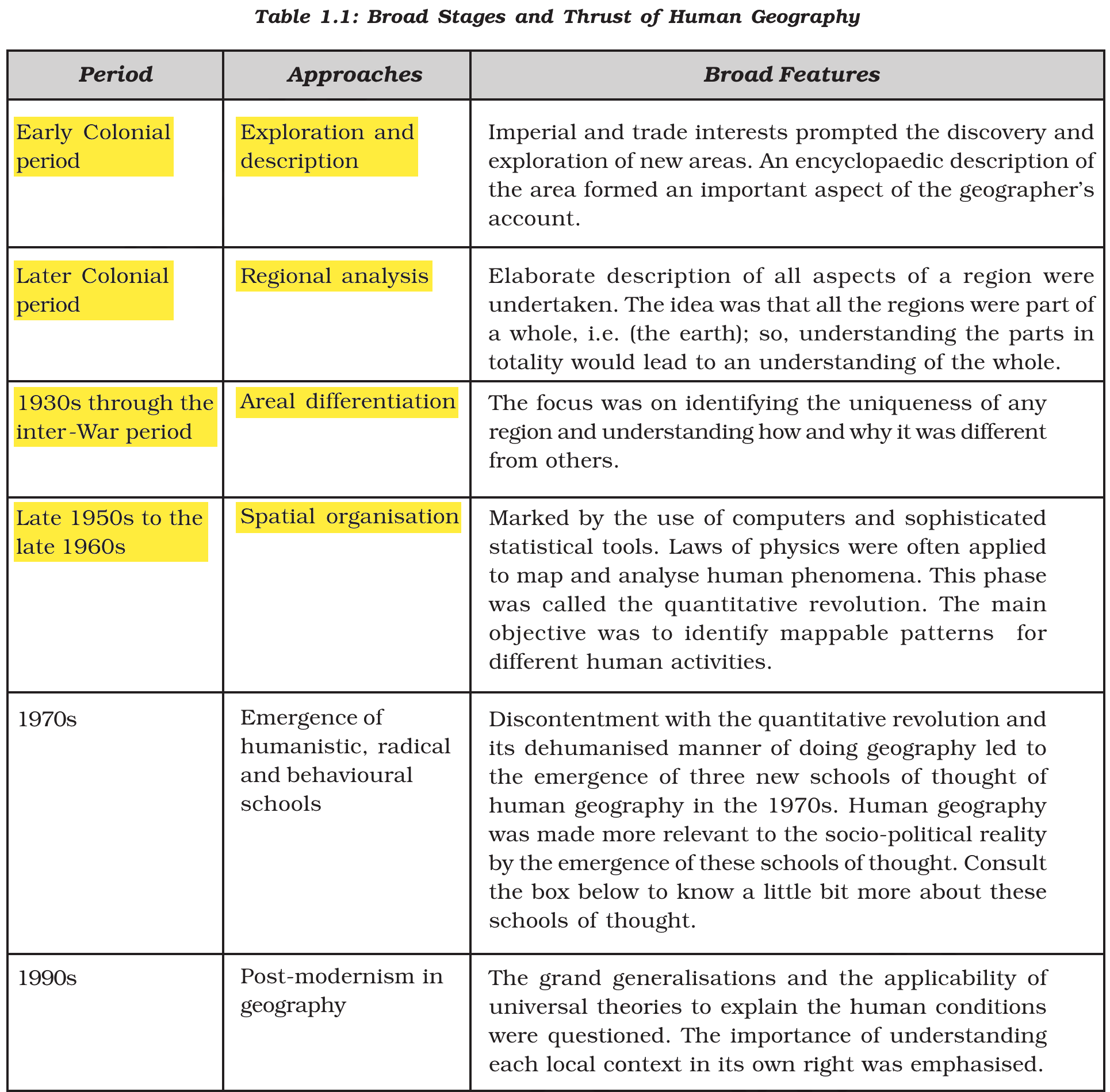
The correct answer is Option (1) → (A)-(III), (B)-(I), (C)-(IV), (D)-(II)
(A) Early colonial period — this matches (III) Exploration and Description. Imperial and trade interests led to the discovery of new areas, and geographers described these areas in detail.
(B) Later colonial period — this matches (I) Regional Analysis. All aspects of a region were described, because all regions were seen as parts of one whole, the earth.
(C) 1930’s through the inter war period — this matches (IV) Areal Differentiation. The focus was on what makes a region unique and how it differs from others.
(D) Late 1950s to late 1960s — this matches (II) Spatial Organisation. Computers and statistical tools were used to find mappable patterns. This was the quantitative revolution.
NCERT (2026-27):
Table 1.1: Broad Stages and Thrust of Human Geography |