
Match List-I with List-II.
| List-I | List-II |
| (A) Saturated solution | (i) Solution that obeys Raoult’s law over the entire range of concentration |
| (B) Binary solution | (ii) Solution in the solid phase |
| (C) Solid solution | (iii) Solution with two components |
| (D) Ideal solution | (iv) Solution that contains the maximum amount of solute that can be dissolved in a given amount of solvent at a given temperature |
Choose the correct answer from the options given below:
Answer & explanation
Correct answer: option 4
The correct answer is Option (4) → A-iv, B-iii, C-ii, D-i
A solution is a homogeneous mixture of two or more components. Each term in List-I names a solution by one feature: how much solute it holds, how many components it has, its physical state, or how it follows Raoult’s law.
(A) Saturated solution — This matches (iv) Solution that contains the maximum amount of solute that can be dissolved in a given amount of solvent at a given temperature. It is in dynamic equilibrium with undissolved solute, so no more solute dissolves at that temperature.
(B) Binary solution — This matches (iii) Solution with two components. “Binary” means made of two parts, one solvent and one solute.
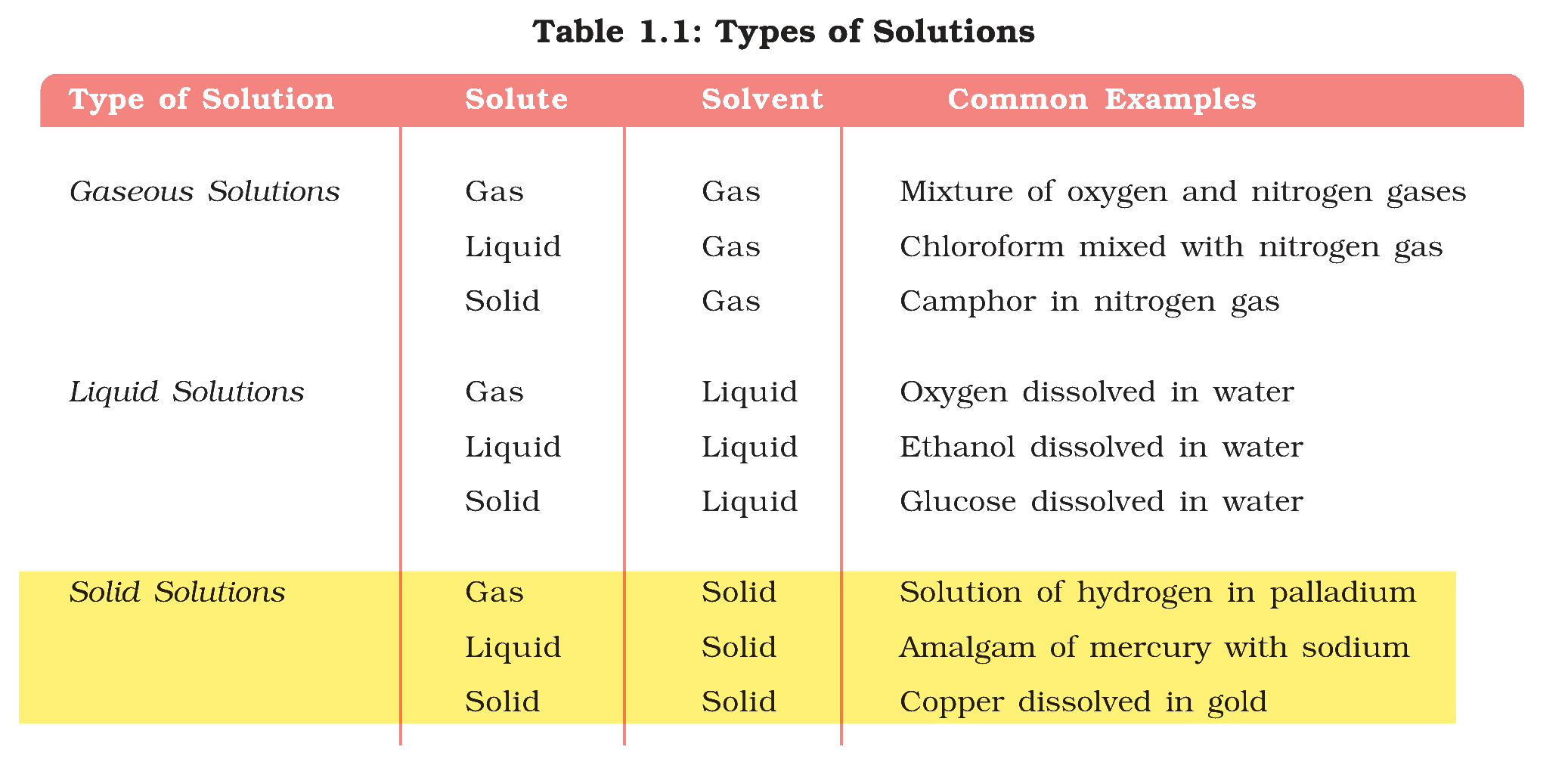
(C) Solid solution — This matches (ii) Solution in the solid phase. The solvent decides the physical state of a solution, so a solution with a solid solvent, such as copper dissolved in gold, is a solid.
(D) Ideal solution — This matches (i) Solution that obeys Raoult’s law over the entire range of concentration.
NCERT (2026-27 edition):
1.3.1 Solubility of a Solid in a Liquid – “… Such a solution in which no more solute can be dissolved at the same temperature and pressure is called a saturated solution. … The solution which is in dynamic equilibrium with undissolved solute is the saturated solution and contains the maximum amount of solute dissolved in a given amount of solvent.”
1.1 Types of Solutions – “… Solvent determines the physical state in which solution exists. One or more components present in the solution other than solvent are called solutes. In this Unit we shall consider only binary solutions (i.e., consisting of two components).”
1.5.1 Ideal Solutions – “The solutions which obey Raoult’s law over the entire range of concentration are known as ideal solutions.”