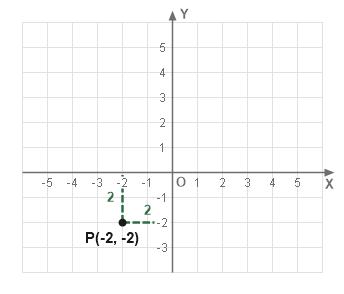
The point \((-2,\,-2)\) is:
Answer & explanation
Correct answer: option 4
The correct answer is Option (4) → equidistant from the x-axis and the y-axis
For a point \((x,\,y)\), the distance from the x-axis is \(|y|\) and the distance from the y-axis is \(|x|\). When \(|x|=|y|\), the point is at the same distance from both axes.
Distance from the x-axis \(=|-2|=2\)
Distance from the y-axis \(=|-2|=2\)
Distance from the origin \(=\sqrt{(-2)^2+(-2)^2}=2\sqrt{2}\approx2.8\), which is more than 2
The two axes are both 2 units away, so the point is equidistant from the two axes