
CUETMOCK
  • Pricing
  • Mentors
Log inStart freeStart free mocks→

First test, then trust

Try a free CUET mock test.

Join 5,00,000+ students who rehearsed exam day on the exact NTA screen before sitting CUET. On the web and on Android.

Start free mocks →Get the Android app
CUETMOCK

India's #1 CUET Mock Test Platform. Original NCERT-based questions on the exact NTA exam screen — trusted by 5,00,000+ students since CUET 2022.

Get it onGoogle PlayScan to download the CUETMOCK app

Mock tests

  • CUET mock test series
  • Commerce mocks
  • Humanities (Arts) mocks
  • Science mocks
  • Languages & GAT mocks
  • Free practice questions
  • Pricing

Resources

  • CUET exam guide
  • CUET syllabus
  • Universities accepting CUET
  • Expert blogs
  • News & notifications
  • Webinars & counselling
  • CUET score calculator
  • How we estimate your rank
  • FAQs

Company

  • About us
  • Our leadership & team
  • Our toppers
  • Mentors
  • For schools
  • Contact us
  • Terms
  • Privacy
  • Refund policy

Talk to us

+91 7696 6630 56info@cuetmock.comWhatsApp us

Our other platforms

  • JEE Mock — For IIT-JEE aspirants
  • NEET Mock — For NEET aspirants

Newsletter

Exam updates, study material and offers — no spam.

© 2026 NYC Ventures Pvt. Ltd.

701-702, Royal Business Park, Zirakpur, Punjab - 140603

  • Terms of use
  • Privacy policy
  • Refund policy
  • Contact us

iCUETMOCK is an independent preparation platform, not affiliated with the National Testing Agency (NTA). Always check exam details on the official NTA website.

  • Home
  • Mock tests
  • CUET guide
  • Pricing
  • Log in
Home/Practice questions/Fine Arts
Fine ArtsThe Rajasthani Schools of Painting

What emotion is attributed to Radha in the given illustration?1) Grie…

Observe the painting and answer the questions:
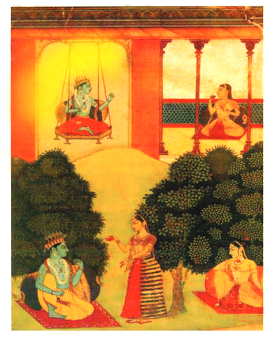
What emotion is attributed to Radha in the given illustration?

1) Grief
2) Bliss
3) Anger
4) Excitement

Answer & explanation+

Correct answer: option 1

The correct answer is Option 1 - 1 (Grief)

A jilted Radha, stricken with grief, disappears into the countryside in the Rasikapriya illustration.

This painting, illustrating Rasikapriya, is notable as it is inscribed with a date and name of the artist. Painted in 1683 by artist Nuruddin, who worked in the court of Bikaner from 1674 to 1698, it presents a stark and simple composition with minimal and suggestive representation of architecture and elements of landscape. Nuruddin has ingeniously employed the device of soft undulating mound in the centre to divide the painting into two sections. It operates as a pictorial prop that transforms an urban setting into a tree-laden countryside and vice versa. An architectural pavilion in the upper part of the painting pictorially qualifies that space as the ‘palatial interior’, while few trees on the green grassland suggest ‘outdoors and pastoral’ landscape. Hence, one understands the movement of the narrative from top to bottom as a progression of activities from indoors to outdoors. Appearing in the upper section of the painting, Krishna seated on a swing seems to be enjoying himself in the company of a Gopi at her dwelling. On learning about his rendezvous a jilted Radha, stricken with grief, disappears into the countryside and finds herself alone under a tree. Guilt-ridden Krishna, on learning of Radha’s sorrow, follows her but there is no truce happening. Meanwhile, Radha’s sakhi (friend) gets to know of the fall out and takes on the role of a messenger and pacifier. She comes to Krishna and tells him of the misery and plight of Radha, and implores him to appease her. This painting is in the collection of National Museum, New Delhi.

Advertisement

Practise more on The Rajasthani Schools of Painting

Chapter-wise mocks on the real NTA exam screen, with solutions and your rank. Your first mocks are free.

Start free mocks →

Advertisement

Next questions

  1. A company receives a dividend of ₹2 Lakhs. In case of a Finance Company, it will be classified under which kind of activity of cash flow st…Accountancy Part B · Cash Flow Statement
  2. Which of the following conditions of the 1790s helps the historian explain the zamindar's failure?History · Modern India: Colonialism and the Countryside
  3. What is the international system dominated by a sole superpower called?Political Science · Contemporary World Politics: US Hegemony in World Politics
  4. निम्नलिखित में से कारक के प्रकार नहीं हैं - A. करणB. अधिकरणC. वाचकD. अव्यय E. कर्ता नीचे दिए गए विकल्पों में से सही उत्तर चुनें:Hindi · व्याकरण - सकारक
  5. _________ School of Thought in Geography is concerned with the different aspects of social well-being of the people.Geography · Fundamentals of Human Geography: Human Geography-Nature and Scope
  6. From the point of view of Tenure, debentures can be of following types: (A) Reedemable Debentures (B) Non-Convertible Debentures (C) Perpet…Accountancy Part A · Issue and Redemption of Debentures
  7. In the eighteenth century, what increasingly became the subject matter of Mewar painting?Fine Arts · The Rajasthani Schools of Painting
  8. Which organization in India is responsible for evaluating the safety of introducing genetically modified organisms for public use?Biology · Biotechnology and its Applications
  9. Which of the following is known as the Brady's reagent?Chemistry · Organic: Aldehydes, Ketones and Carboxylic Acids
  10. Read the following statements about the disadvantages of chemical agents: (I) Chemicals pose a threat to human beings and animals due to th…Biology · Microbes in Human Welfare