
An azeotropic mixture of two liquids boils at a lower temperature than either of the pure liquids. Why?
Answer & explanation
Correct answer: option 4
The correct answer is Option (4) → It shows a positive deviation from Raoult’s law
In a solution with positive deviation, the A–B attractions are weaker than the A–A and B–B attractions. Molecules escape more easily, so the vapour pressure is higher than Raoult’s law predicts.
A higher vapour pressure reaches the outside pressure at a lower temperature, so at one composition the mixture boils below both pure liquids: a minimum boiling azeotrope.
Why the other options are incorrect
Option (1) It is saturated — Incorrect. Saturation refers to the largest amount of solute that can dissolve; it says nothing about how the vapour pressure of a liquid mixture compares with Raoult’s law.
Option (2) It does not deviate from Raoult’s law — Incorrect. An ideal solution obeys Raoult’s law over the entire range of concentration; azeotropes are formed only by solutions with a large deviation from the law.
Option (3) It shows a negative deviation from Raoult’s law — Incorrect. Negative deviation lowers the vapour pressure, so the azeotrope formed is a maximum boiling azeotrope, which boils above both liquids.
NCERT (2026-27 edition):
1.5.2 Non-ideal Solutions – “The cause for these deviations lie in the nature of interactions at the molecular level. In case of positive deviation from Raoult’s law, A-B interactions are weaker than those between A-A or B-B … This will increase the vapour pressure and result in positive deviation. … The solutions which show a large positive deviation from Raoult’s law form minimum boiling azeotrope at a specific composition. … The solutions that show large negative deviation from Raoult’s law form maximum boiling azeotrope at a specific composition.”
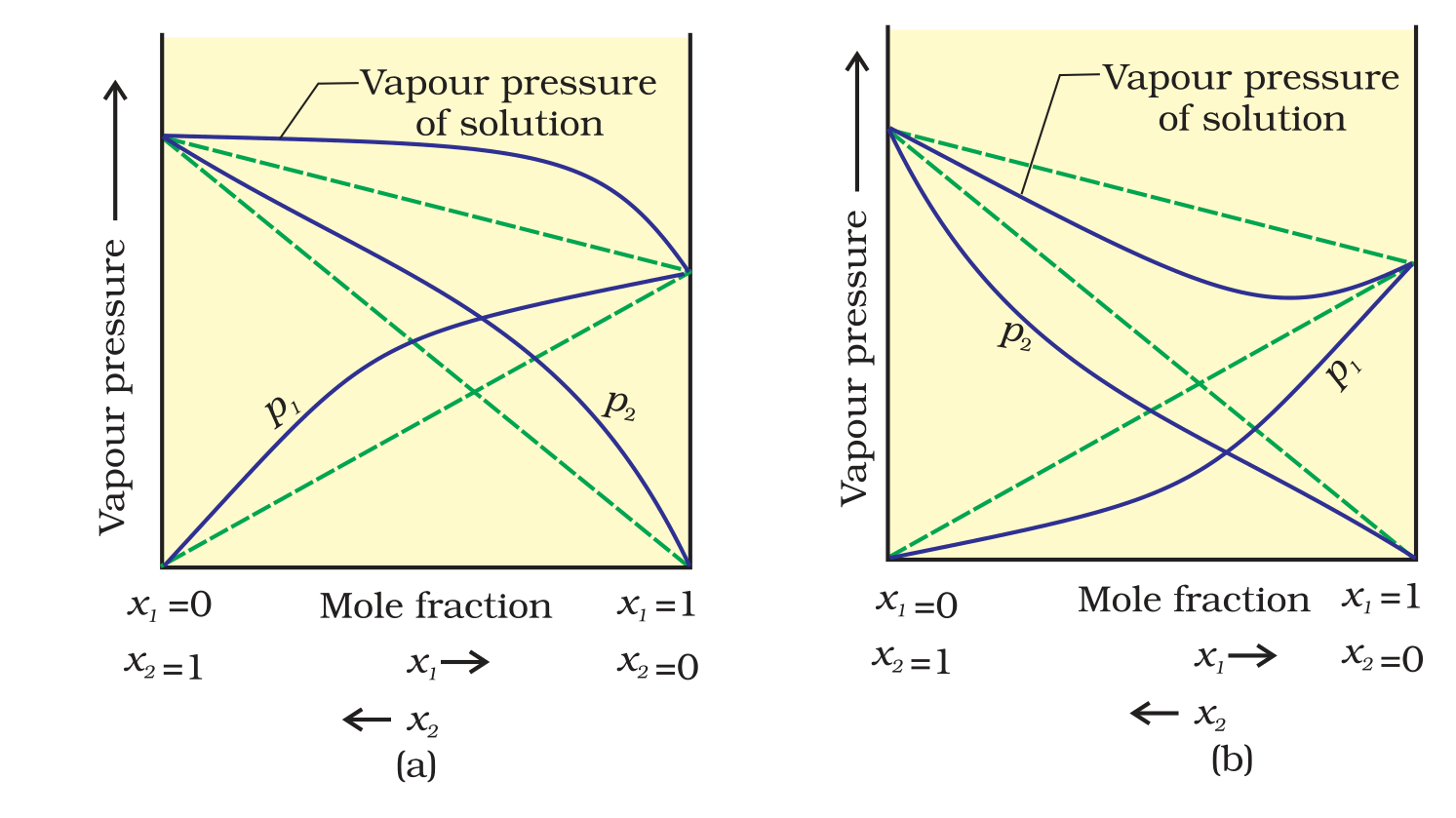
Fig. 1.6: The vapour pressures of two component systems as a function of composition (a) a solution that shows positive deviation from Raoult’s law and (b) a solution that shows negative deviation from Raoult’s law.