
Case based
The British physicist Thomas used an ingenious technique to lock the phases of the waves emanating from two coherent sources \( S_1 \) and \( S_2 \). As these sources were derived from same source symmetrically placed wrt \( S_1 \) and \( S_2 \), the phases of waves were same. If any abrupt change happens in original sources, will manifest exactly similar phase changes in the light coming out of two sources \( S_1 \) to \( S_2 \). Due to constructive interference and destructive interference at different points in space and screen alternate dark and bright fringes of equal width were obtained. This pattern was called as interference pattern. The width of each band was equal with central fringe as bright fringe.
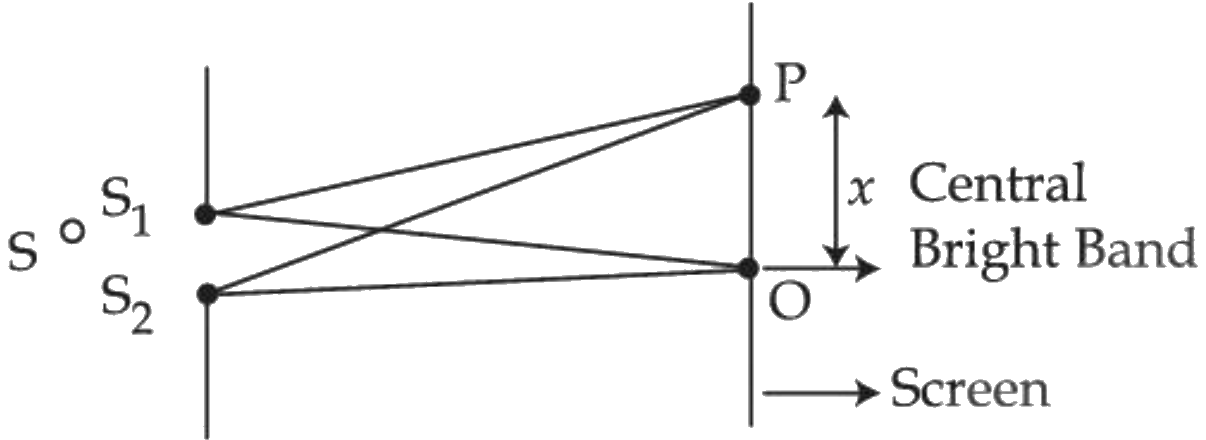
The phase difference \( (\Delta\phi) \) between two superimposing waves to obtain constructive interference and hence bright band, is:
Answer & explanation
Correct answer: option 1
The correct answer is Option (1) → \( \Delta\phi = 2\pi n;\ n = 0, 1, 2, 3, \ldots \)
A bright band is formed where the two waves arrive in phase (constructive interference). This happens when the path difference is a whole number of wavelengths, \( n\lambda \). The phase difference is \( 2\pi/\lambda \) times the path difference:
\( \displaystyle \Delta\phi = \frac{2\pi}{\lambda} \times n\lambda = 2\pi n, \quad n = 0, 1, 2, 3, \ldots \)
So the phase difference must be an even multiple of \( \pi \); an odd multiple of \( \pi \) gives a dark band.
Option (1) \( \Delta\phi = 2\pi n;\ n = 0, 1, 2, 3, \ldots \) — Correct. Every even multiple of \( \pi \), starting with \( n = 0 \) for the central bright fringe, gives a bright band.
Option (2) \( \Delta\phi = \pi n;\ n = 0, 2, 3, 4, 5 \) — Incorrect. For \( n = 3 \) and \( n = 5 \) it gives \( 3\pi \) and \( 5\pi \), odd multiples of \( \pi \), which give dark bands.
Option (3) \( \Delta\phi = \displaystyle\frac{n\pi}{2} \quad n = 1, 2, 3, 4, 5 \) — Incorrect. It gives \( \pi/2, \pi, 3\pi/2, 2\pi, 5\pi/2 \); only \( n = 4 \) in the list gives a multiple of \( 2\pi \).
Option (4) \( \Delta\phi = \displaystyle\frac{3n\pi}{2} \quad n = 1, 2, 3, 4, 5 \) — Incorrect. It gives \( 3\pi/2, 3\pi, 9\pi/2, 6\pi, 15\pi/2 \); only \( n = 4 \) in the list gives a multiple of \( 2\pi \).
NCERT (2026-27):
Coherent and Incoherent Addition of Waves – “… If \( \phi = 0, \pm 2\pi, \pm 4\pi, \ldots \) which corresponds to the condition given by Eq. (10.9) we will have constructive interference leading to maximum intensity.”