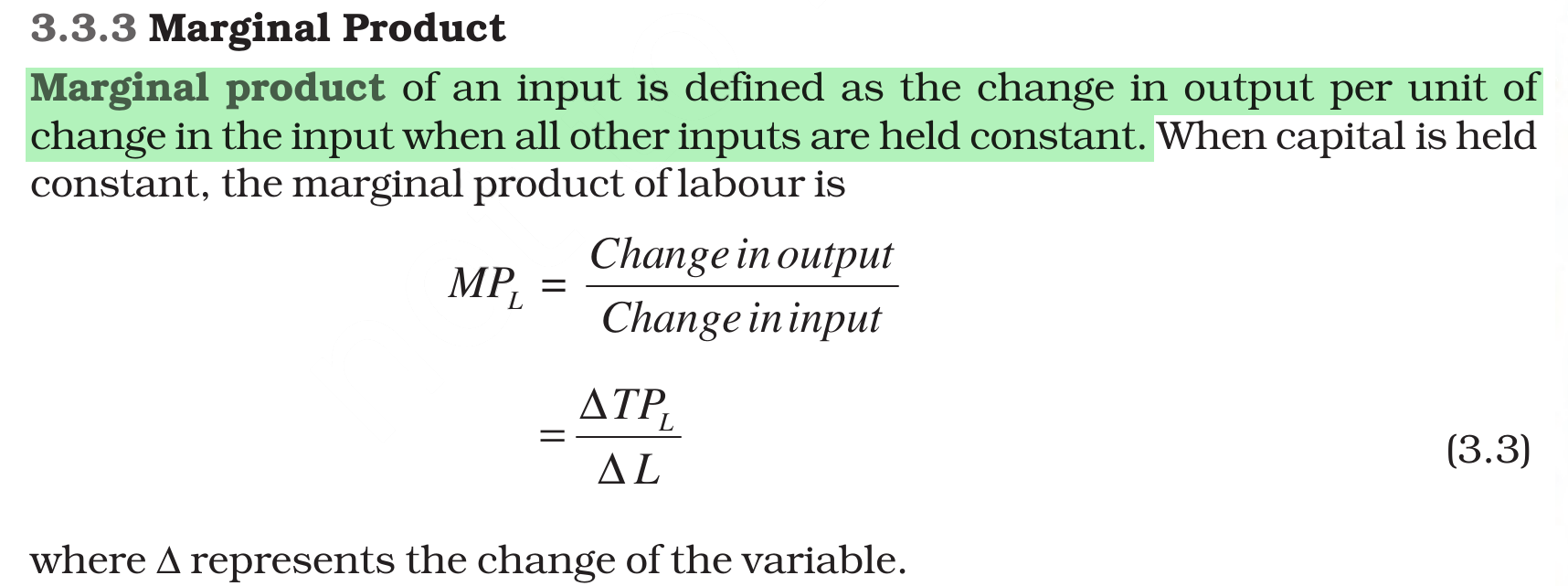
_______ of an input is defined as the change in output per unit of change in the input when all other inputs are remain constant.
Answer & explanation
Correct answer: option 1
The correct answer is Option (1) → Marginal Product.
When a firm adds one more unit of an input while keeping the other inputs unchanged, output changes. This change in output per unit of change in the input, with all other inputs held constant, is the marginal product of that input. For labour, MPL = ΔTP/ΔL: if a fifth worker raises output from 40 to 48 units, the marginal product of labour is 8 units.
Why the other options are incorrect
Option (2) Average Product. — Incorrect. Average product is output per unit of the variable input, TP/L, an average over all units, not the effect of the last one.
Option (3) Total Product. — Incorrect. Total product is the whole output at each level of the input, not the change in it.
Option (4) Returns to Scale. — Incorrect. Returns to scale describe how output changes when all inputs are increased together in the same proportion, a long-run idea; marginal product changes one input alone.
Note: A same/similar question was asked in CUET (UG) in the papers below.
| 2026 | 2025 | 2024 | 2023 | 2022 |
| – | 13-05 S1 22-05 S1* 03-06 S2* | – | – | – |
* A similar question.
NCERT (2026-27): Introductory Microeconomics — Chapter 3: Production and Costs
|