Read the passage on a Deccani painting and answer the question that follows.
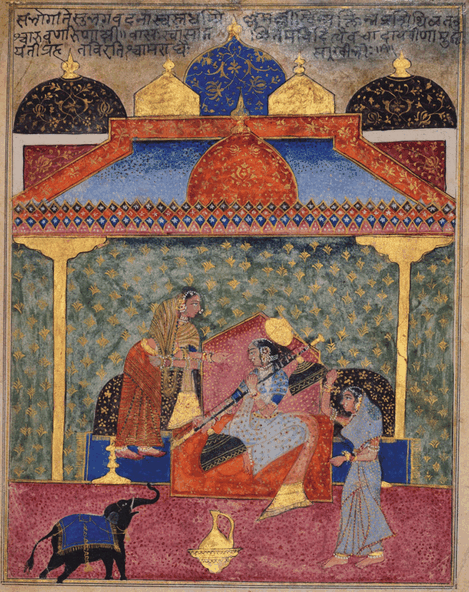
Ragini Pathamsika of Raga Hindola, in the National Museum, New Delhi, belongs to the Ragamala family of the Indian musical mode. Persian influence shows in the arabesque on its two domes. Two bejewelled women are seen in a pavilion and a third outside it, while a small dark elephant breaks the architectonic structuring.
Painting in the Deccani states, where this work was made, developed almost at the same time as which school of painting?
Answer & explanation
Correct answer: option 2
The correct answer is Option (2) → The Mughal School of Painting
Option (1) The Pahari School of Painting — Incorrect. This school grew in the hill states of the western Himalaya. It is not the school whose growth ran alongside Deccani painting.
Option (2) The Mughal School of Painting — Correct. Painting in the Deccani states was highly developed almost simultaneously with the Mughal School.
Option (3) The Bengal School of Painting — Incorrect. This school arose in the early twentieth century with cultural nationalism, centuries after the Deccani courts.
Option (4) The Rajasthani School of Painting — Incorrect. This school grew at the Rajput courts of Rajasthan. It is not the school named alongside Deccani painting.
NCERT (2026-27): “Ragini Pathamsika of Raga Hindola An intriguing work in the collection of National Museum, New Delhi, titled Ragini Pathamsika of Raga Hindola, an important member of the Ragamala family of the Indian musical mode, dates back to around 1590–95. Some scholars believe it to be from Bijapur, an important state of Deccan. Painting was a highly developed art form in the Deccani states, almost simultaneous with the development of the Mughal School of Painting.…”
|