
CUETMOCK
  • Pricing
  • Mentors
Log inStart freeStart free mocks→

First test, then trust

Try a free CUET mock test.

Join 5,00,000+ students who rehearsed exam day on the exact NTA screen before sitting CUET. On the web and on Android.

Start free mocks →Get the Android app
CUETMOCK

India's #1 CUET Mock Test Platform. Original NCERT-based questions on the exact NTA exam screen — trusted by 5,00,000+ students since CUET 2022.

Get it onGoogle PlayScan to download the CUETMOCK app

Mock tests

  • CUET mock test series
  • Commerce mocks
  • Humanities (Arts) mocks
  • Science mocks
  • Languages & GAT mocks
  • Free practice questions
  • Pricing

Resources

  • CUET exam guide
  • CUET syllabus
  • Universities accepting CUET
  • Expert blogs
  • News & notifications
  • Webinars & counselling
  • CUET score calculator
  • How we estimate your rank
  • FAQs

Company

  • About us
  • Our leadership & team
  • Our toppers
  • Mentors
  • For schools
  • Contact us
  • Terms
  • Privacy
  • Refund policy

Talk to us

+91 7696 6630 56info@cuetmock.comWhatsApp us

Our other platforms

  • JEE Mock — For IIT-JEE aspirants
  • NEET Mock — For NEET aspirants

Newsletter

Exam updates, study material and offers — no spam.

© 2026 NYC Ventures Pvt. Ltd.

701-702, Royal Business Park, Zirakpur, Punjab - 140603

  • Terms of use
  • Privacy policy
  • Refund policy
  • Contact us

iCUETMOCK is an independent preparation platform, not affiliated with the National Testing Agency (NTA). Always check exam details on the official NTA website.

  • Home
  • Mock tests
  • CUET guide
  • Pricing
  • Log in
Home/Practice questions/Chemistry
ChemistryInorganic: D and F Block Elements

Match List-I (feature of the oxidation states of a first row transiti…

Match List-I (feature of the oxidation states of a first row transition element) with List-II (element).

List-IList-II
(A) Shows all the oxidation states from +2 to +7(I) Scandium
(B) Its only oxidation state is +2, as no d electrons are involved(II) Manganese
(C) Its +2 state is virtually unknown; it shows only the +3 state(III) Copper
(D) Shows the +1 oxidation state besides its common +2 state(IV) Zinc

Choose the correct answer from the options given below:

Answer & explanation+

Correct answer: option 4

The correct answer is Option (4) → A-II, B-IV, C-I, D-III

The oxidation states of a transition element come from its ns and (n−1)d electrons. Elements in the middle of the series show the most oxidation states; those at the two ends show fewer, because they have too few electrons to lose or too many d electrons to share.

(A) Shows all the oxidation states from +2 to +7 — This matches (II) Manganese. Mn (3d5 4s2) can use up to all seven of its 4s and 3d electrons, so it shows every state from +2 to +7, as in MnO4− (+7).

(B) Its only oxidation state is +2, as no d electrons are involved — This matches (IV) Zinc. Zn (3d10 4s2) loses only its two 4s electrons; the filled 3d10 set takes no part, so +2 is its only state.

(C) Its +2 state is virtually unknown; it shows only the +3 state — This matches (I) Scandium. Sc (3d1 4s2) has too few electrons for variety; it loses all three to form Sc3+, and scandium(II) is virtually unknown.

(D) Shows the +1 oxidation state besides its common +2 state — This matches (III) Copper. Cu (3d10 4s1) forms Cu+ (3d10) by losing its 4s electron, and its common state is +2; in Table 4.3 the +1 state is listed only for copper.

NCERT (2026-27 edition):
4.3.4 Oxidation States – “The elements which give the greatest number of oxidation states occur in or near the middle of the series. Manganese, for example, exhibits all the oxidation states from +2 to +7. The lesser number of oxidation states at the extreme ends stems from either too few electrons to lose or share (Sc, Ti) or too many d electrons (hence fewer orbitals available in which to share electrons with others) for higher valence (Cu, Zn). Thus, early in the series scandium(II) is virtually unknown and titanium (IV) is more stable than Ti(III) or Ti(II). At the other end, the only oxidation state of zinc is +2 (no d electrons are involved).”

“One of the notable features of a transition elements is the great variety of oxidation states these may show in their compounds. Table 4.3 lists the common oxidation states of the first row transition elements.”

Table 4.3: Oxidation States of the first row Transition Metal (the most common ones are in bold types)
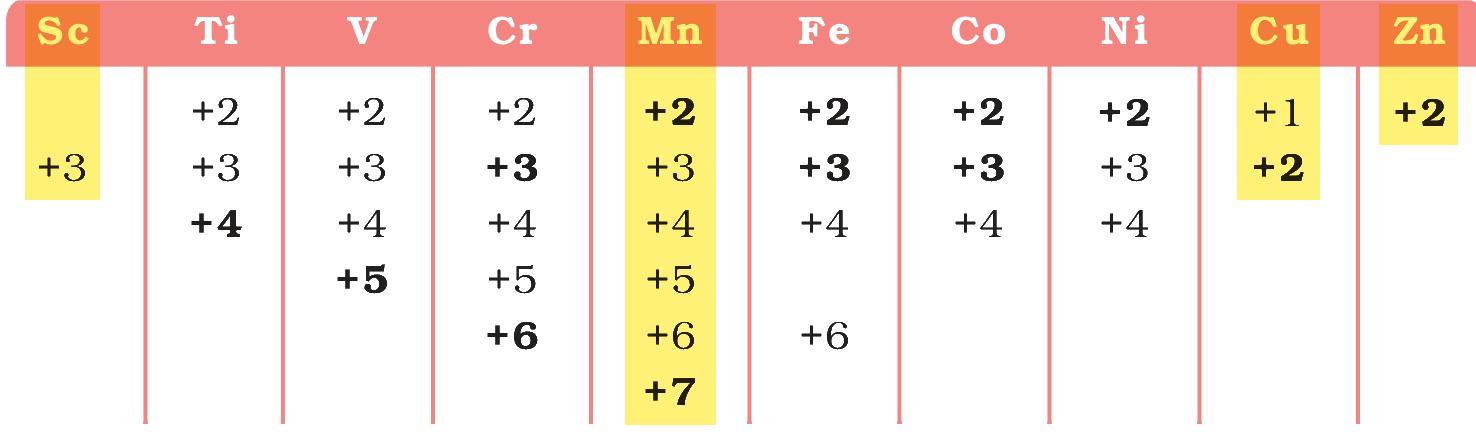
Table 4.3

Advertisement

Practise more on Inorganic: D and F Block Elements

Chapter-wise mocks on the real NTA exam screen, with solutions and your rank. Your first mocks are free.

Start free mocks →

Advertisement

Next questions

  1. A sum of money at compound interest, compounded annually, amounts to Rs 9000 after 2 years and to Rs 12960 after 4 years. Find the sum.General Aptitude Test · Numerical Ability
  2. A painting shows Chand Bibi, a Deccani queen, at a royal sport. Given below are two statements, one labelled as Assertion (A) and the other…Fine Arts · The Deccani Schools of Painting
  3. Given below are two statements:Assertion (A): Organisations which use assets that are prone to obsolescence require a lower amount of fixed…Business Studies · Financial Management
  4. Select the most appropriate meaning of the given Idiom:- Hope against hopeEnglish · Grammar: Idioms
  5. सूची-I का सूची-II से मिलान कीजिएसूची-Iसूची-IIA. हरड़I. हृदयB. हल्दीII. हस्तीC. हाथीIII. हरिद्राD. हियाIV. हरीतकीनिम्नलिखित विकल्पों में से…Hindi · व्याकरण - सशब्द विचार
  6. अनल और मधु के मिश्रण किन्हें कहा गया है?Hindi · Comprehension - (Narrative / Factual)
  7. What is the primary application of Polymerase Chain Reaction (PCR)?Biology · Biotechnology and its Applications
  8. Given below are two statements: one is labelled as Assertion (A) and the other is labelled as Reason (R).Assertion (A): Many rural people m…Economics · Indian Economic Development: Employment - Growth, Informalisation and Other Issues
  9. Let A be a square matrix of order 3, then |xA| is equal toMaths. Section B1 · Determinants
  10. Select the option that is related to the third word in the same way as the second word is related to the first word. Work : Joule :: Area :…General Aptitude Test · General Ability