Amino acids show higher melting points and are soluble in water because of
Answer & explanation
Correct answer: option 1
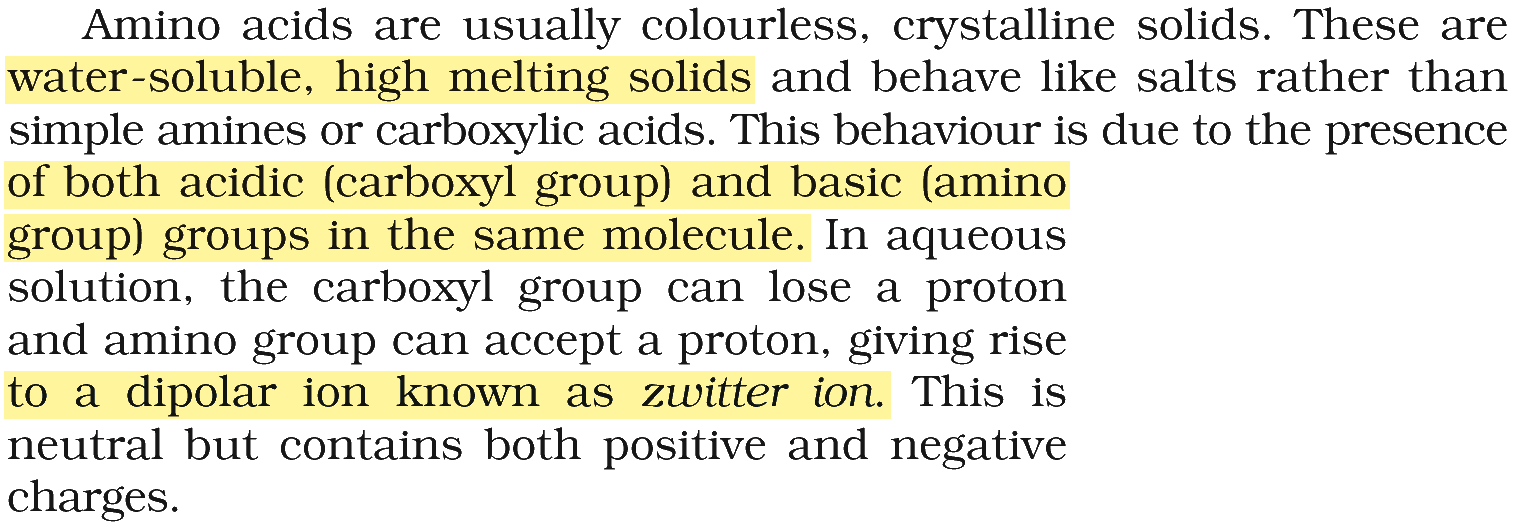
The correct answer is Option (1) → the presence of both acidic ( carboxylic group) and basic ( amino group) groups in the same amino acid and zwitter ionic nature.
An amino acid contains an acidic –COOH group and a basic –\( \ce{NH2} \) group in the same molecule. In aqueous solution and in the solid state, the carboxyl group loses a proton and the amino group accepts it, forming a dipolar ion called a zwitter ion:
\( \displaystyle \ce{H2N-CHR-COOH <=> H3N^+-CHR-COO^-} \)
Because amino acids exist as zwitter ions, they behave like salts: the strong attractions between the charged ions give high melting points, and the attraction of the charged groups for polar water molecules makes them soluble in water.
Why the other options are incorrect
Option (2) their non polar nature. — Incorrect. Amino acids are highly polar (ionic); non-polar compounds would be insoluble in water.
Option (3) their non crystalline nature. — Incorrect. Amino acids are crystalline solids; their ordered ionic lattice is the reason for the high melting points.
Option (4) presence of non-polar side chains. — Incorrect. Only some amino acids have non-polar side chains, and non-polar groups would lower water solubility, not raise it.
NCERT (2026-27 edition):
Classification of Amino Acids – …