Tools of Biotechnology
Read the following passage carefully and answer the given questions.
It is evident that genetic engineering or recombinant DNA technology can be accomplished only if we have the key tools, i.e., restriction enzymes, polymerase enzymes, ligases, vectors and the host organism. DNA fragments are negatively charged molecules which can be separated by forcing them to move towards the anode under an electric field through a medium. Nowadays the most commonly used matrix is agarose which is a natural polymer extracted from sea weeds. The DNA fragments are resolved according to their size through sieving effect provided by the agarose gel. Hence, the smaller the fragment size, the farther it moves. If the process of replication of DNA is repeated many times, the segment of DNA can be amplified to approximately billion times. Such repeated amplification is achieved by the use of a thermostable DNA polymerase, which remain active during high temperature.
The stickiness of the ends of DNA facilitates the action of:
Answer & explanation
Correct answer: option 1
The correct answer is Option (1) → DNA ligase
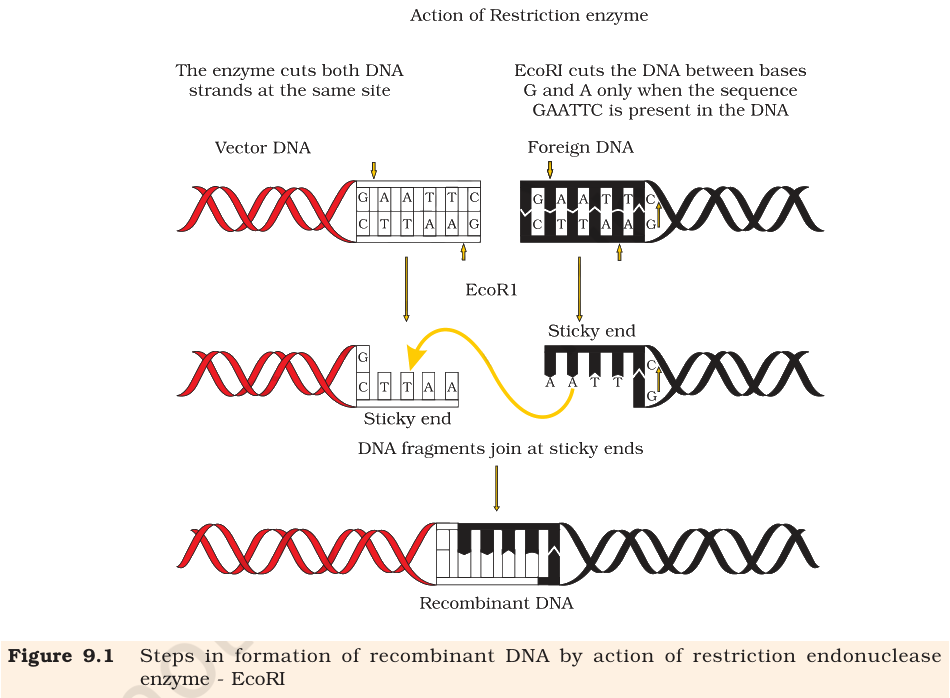
A restriction enzyme cuts the two strands of DNA a little apart, which leaves short single-stranded overhangs. These are the sticky ends. They bind to a matching sticky end by hydrogen bonds.
(1) DNA ligase — Correct. Two sticky ends that have paired can be sealed into one molecule by DNA ligase. The stickiness holds the ends together so that the ligase can join them.
(2) DNA polymerase — Incorrect. This enzyme makes new DNA strands by adding nucleotides, as in replication and PCR.
(3) RNA polymerase — Incorrect. This enzyme makes RNA from a DNA template in transcription.
(4) Endonuclease — Incorrect. A restriction endonuclease is the enzyme that cuts the DNA and makes the sticky ends. It acts before the ends are stuck together.
Note: The passage is taken from NCERT. NTA has put lines of the NCERT text together to make it. Most CUET (UG) questions come straight from NCERT, so study the book line by line, including figures and their titles.
NCERT Extract:
Restriction Enzymes – “… Restriction enzymes cut the strand of DNA a little away from the centre of the palindrome sites, but between the same two bases on the opposite strands. This leaves single stranded portions at the ends. There are overhanging stretches called sticky ends on each strand (Figure 9.1). These are named so because they form hydrogen bonds with their complementary cut counterparts. This stickiness of the ends facilitates the action of the enzyme DNA ligase.”