
Potassium tetraiodomercurate(II) is the IUPAC name of which of the following complex?
Answer & explanation
Correct answer: option 3
The correct answer is Option (3) → K2[HgI4]
To write the formula from a name, read the name in parts:
The cation is named first and the anion second. Here the cation is potassium, \( \ce{K^{+}} \).
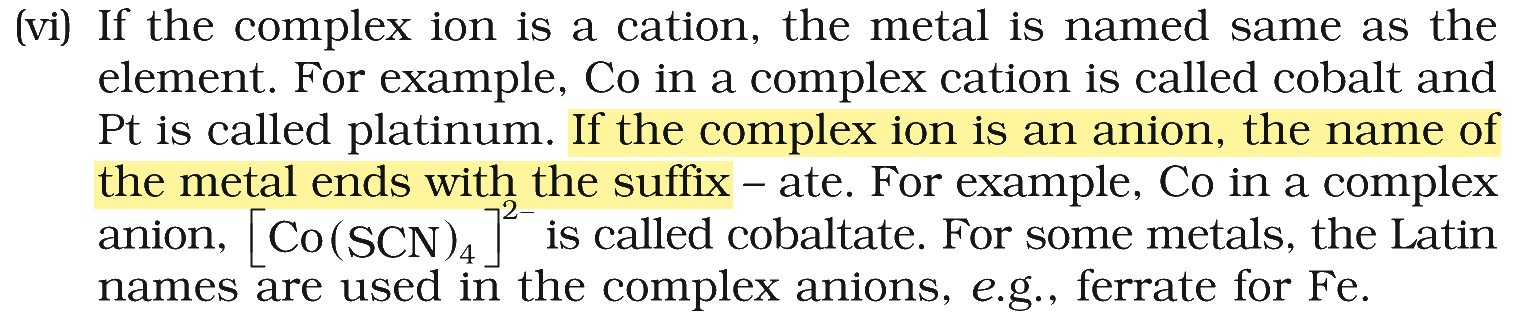
The ending -ate shows that the complex is an anion; “mercurate” means mercury is the central metal.
“Tetraiodo” means four iodide ligands (\( \ce{I^{-}} \)), and (II) is the oxidation state of mercury.
The complex ion is written inside square brackets, and the number of counter ions is chosen so that the total charge is zero.
Charge on the complex ion:
\( \displaystyle \text{Charge}=(+2)+4(-1)=-2,\quad \text{so the ion is }\ce{[HgI4]^2-} \)
Two \( \ce{K^{+}} \) ions balance the −2 charge. So the formula is K2[HgI4].
Why the other options are incorrect
Option (1) K[(HgI4)]2 — Incorrect. It shows one \( \ce{K^{+}} \) with two \( \ce{[HgI4]^{2-}} \) ions, a total charge of −3, so it is not neutral.
Option (2) K[(Hg2(IO)4)] — Incorrect. It has two mercury atoms and IO (hypoiodite) ligands instead of iodide ligands, so it does not match “tetraiodo” or a single mercury atom.
Option (4) K2[(HgI4)2] — Incorrect. Two complex anions carry a charge of −4, which two \( \ce{K^{+}} \) ions cannot balance.
NCERT (2026-27 edition):
Naming of Mononuclear Coordination Compounds – …
Naming of Mononuclear Coordination Compounds – “… (iii) Names of the anionic ligands end in –o, those of neutral and cationic ligands are the same except aqua for H2O, ammine for NH3, carbonyl for CO and nitrosyl for NO. While writing the formula of coordination entity, these are enclosed in brackets ( ).”