CUETMOCK
  • Pricing
  • Mentors
Log inStart freeStart free mocks→

First test, then trust

Try a free CUET mock test.

Join 5,00,000+ students who rehearsed exam day on the exact NTA screen before sitting CUET. On the web and on Android.

Start free mocks →Get the Android app
CUETMOCK

India's #1 CUET Mock Test Platform. Original NCERT-based questions on the exact NTA exam screen — trusted by 5,00,000+ students since CUET 2022.

Get it onGoogle PlayScan to download the CUETMOCK app

Mock tests

  • CUET mock test series
  • Commerce mocks
  • Humanities (Arts) mocks
  • Science mocks
  • Languages & GAT mocks
  • Free practice questions
  • Pricing

Resources

  • CUET exam guide
  • CUET syllabus
  • Universities accepting CUET
  • Expert blogs
  • News & notifications
  • Webinars & counselling
  • CUET score calculator
  • How we estimate your rank
  • FAQs

Company

  • About us
  • Our leadership & team
  • Our toppers
  • Mentors
  • For schools
  • Contact us
  • Terms
  • Privacy
  • Refund policy

Talk to us

+91 7696 6630 56info@cuetmock.comWhatsApp us

Our other platforms

  • JEE Mock — For IIT-JEE aspirants
  • NEET Mock — For NEET aspirants

Newsletter

Exam updates, study material and offers — no spam.

© 2026 NYC Ventures Pvt. Ltd.

701-702, Royal Business Park, Zirakpur, Punjab - 140603

  • Terms of use
  • Privacy policy
  • Refund policy
  • Contact us

iCUETMOCK is an independent preparation platform, not affiliated with the National Testing Agency (NTA). Always check exam details on the official NTA website.

  • Home
  • Mock tests
  • CUET guide
  • Pricing
  • Log in
Home/Practice questions/Chemistry
ChemistryInorganic: Coordination Compounds

The subscript ‘g’ is used in crystal field theory for complexes due to

Coordination Compounds

Alfred Werner (1866-1919), a Swiss chemist was the first to formulate his ideas about the structures of coordination compounds. He prepared and characterised a large number of coordination compounds and studied their physical and chemical behaviour by simple experimental techniques. Werner proposed the concept of a primary valence and a secondary valence for a metal ion. The formulas and names adopted for coordination entities are based on the recommendations of the International Union of Pure and Applied Chemistry (IUPAC). Many approaches have been put forth to explain the nature of bonding in coordination compounds viz. Valence Bond Theory (VBT), Crystal Field Theory (CFT), Ligand Field Theory (LFT) and Molecular Orbital Theory (MOT). The Valence Bond Theory (VBT) explains with reasonable success, the formation, magnetic behaviour and geometrical shapes of coordination compounds. It, however, fails to provide a quantitative interpretation of magnetic behaviour and has nothing to say about the optical properties of these compounds. The Crystal Field Theory (CFT) to coordination compounds is based on the effect of different crystal fields (provided by the ligands taken as point charges), on the degeneracy of d orbital energies of the central metal atom/ion. The splitting of the d orbitals provides different electronic arrangements in strong and weak crystal fields. The treatment provides for quantitative estimations of orbital separation energies, magnetic moments and spectral and stability parameters. However, the assumption that ligands constitute point charges creates many theoretical difficulties.

The subscript ‘g’ is used in crystal field theory for complexes due to

Answer & explanation+

Correct answer: option 2

The correct answer is Option (2) → Centre of symmetry

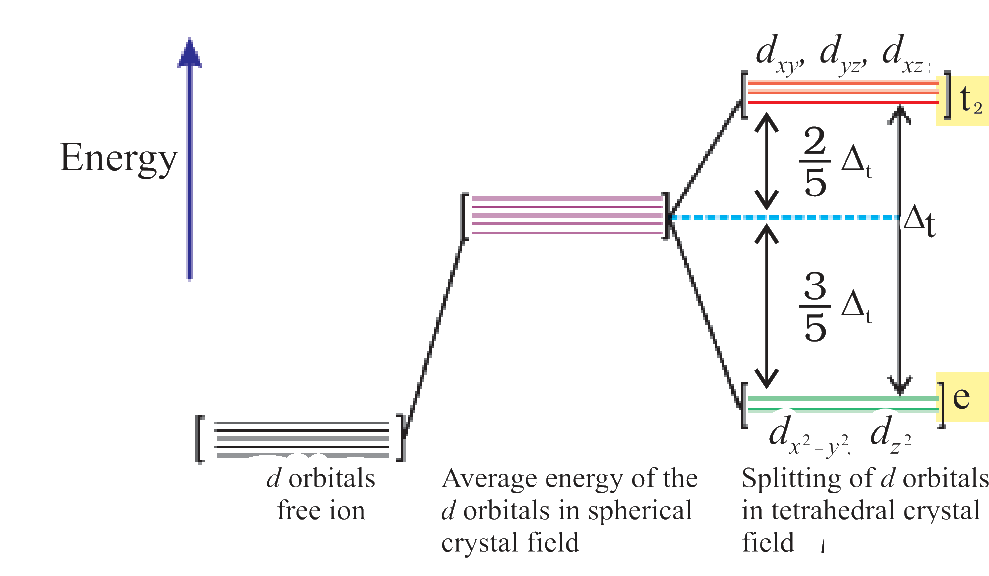
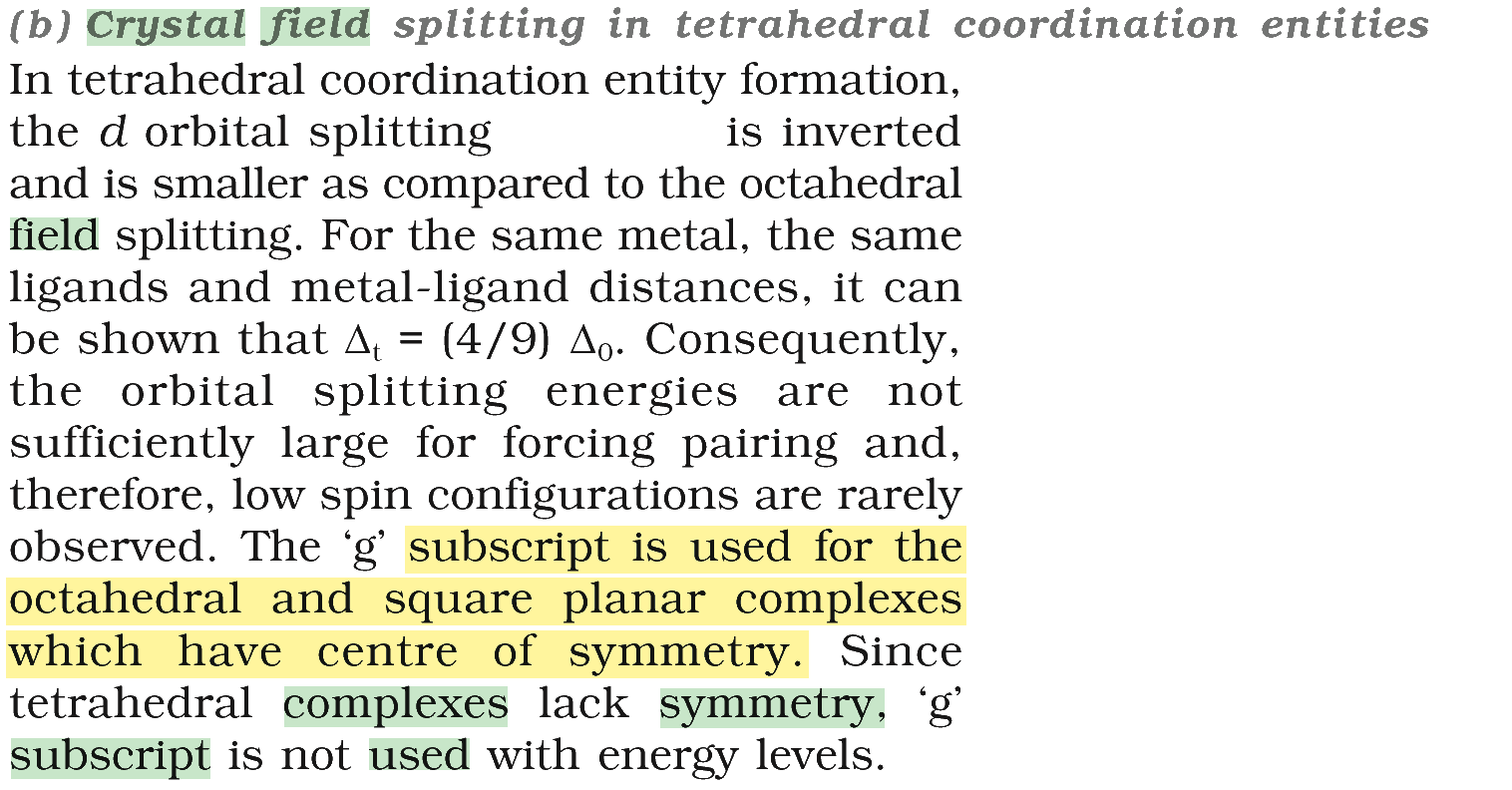
In crystal field theory, the split d orbitals are given symmetry labels. The subscript g comes from the German word gerade, meaning “even”. It is used for orbitals that stay the same when every point is reflected through the centre of symmetry (centre of inversion).

  • Octahedral complexes have a centre of symmetry at the metal, so the d orbitals split into t2g and eg sets.

So the subscript g is used because of the centre of symmetry.

Why the other options are incorrect

  • Option (1) lack of symmetry — Incorrect. Without a centre of symmetry the subscript g is dropped, as in tetrahedral complexes.

  • Option (3) Tetrahedral complexes — Incorrect. Tetrahedral complexes have no centre of symmetry, so their labels are t2 and e.

  • Option (4) Plane of symmetry — Incorrect. The subscript refers to inversion through a centre, not to reflection in a plane.

NCERT (2026-27 edition):
Crystal Field Theory – …
Textbook extract

Textbook figure

Advertisement

Practise more on Inorganic: Coordination Compounds

Chapter-wise mocks on the real NTA exam screen, with solutions and your rank. Your first mocks are free.

Start free mocks →

Advertisement

Next questions

  1. Which one of the following is NOT the characteristic of factory farming?Geography · Fundamentals of Human Geography: Primary Activities
  2. What is the total number of Union Territories in India?General Aptitude Test · General Knowledge
  3. Which of the following amine shows highest basic strength in aqueous solution ?Chemistry · Organic: Amines
  4. Arrange the following steps of the planning process in correct order:A. Selecting an alternativeB. Setting objectives and developing premis…Business Studies · Planning
  5. Which among the following is not a characteristic of Management?Business Studies · Nature and significance of Management
  6. Given that Y_3× k , W_n× 3 and P_p× k are matrices of specified order, then the condition for n, p, k so that 3PY + 2 WY is well defined, i…Maths. Section A · Matrices
  7. The resistivity (ρ) of aluminum wire is 2.6×10^-8\ Ωm . The resistance of the aluminum wire of length 60 cm and cross-sectional area 3\ mat…Physics · Current Electricity
  8. Match the LIST-I with LIST-IILIST-I(Levels of Intellectual Disability)LIST-II(IQ Range)A.MildI.(IQs 35-40 to approximately 50-55)B.Moderate…Psychology · Variations in Psychological Attributes
  9. What category of functions is used in this formula: =PMT(C10/12,C8,C9,1)?Accountancy Part C · Use of Spreadsheet in Business Applications
  10. Arrange the following in the decreasing order of their band gap energy.(A) Carbon (diamond)(B) Germanium(C) Metal(D) SiliconChoose the corr…Physics · Semiconductors and Electronic Devices