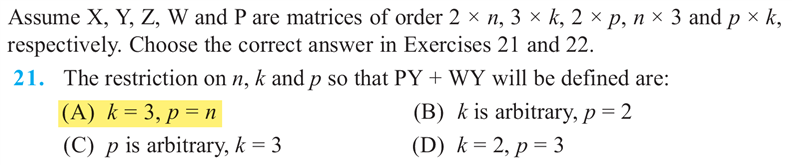
Given that \( \mathrm{Y}_{3\times k} \), \( \mathrm{W}_{n\times 3} \) and \( \mathrm{P}_{p\times k} \) are matrices of specified order, then the condition for n, p, k so that 3PY + 2 WY is well defined, is:
Answer & explanation
Correct answer: option 1
The correct answer is Option (1) → \( p=n \) & \( k=3 \)
Multiplying a matrix by a scalar (3 or 2) does not change its order, so we only need PY and WY to exist and to have the same order.
For PY: the number of columns of P must equal the number of rows of Y.
\( \displaystyle \mathrm{P}_{p\times k}\,\mathrm{Y}_{3\times k}\ \text{is defined only if}\ k=3 \)
\( \displaystyle \text{order of PY}=p\times 3 \)
For WY: W has 3 columns and Y has 3 rows, so WY is defined.
\( \displaystyle \text{order of WY}=n\times 3 \)
Two matrices can be added only when their orders are equal:
\( \displaystyle p\times 3=n\times 3\ \Rightarrow\ p=n \)
So the conditions are \( p=n \) and \( k=3 \).
Why the other options are incorrect
Option (2) \( 2p=n \) & \( k=3 \) — Incorrect. The scalars 3 and 2 do not affect the orders of the matrices, so they do not enter the condition; the rows of PY and WY must be equal, p = n.
Option (3) \( p=2n \) & k is any natural number \( \gt 1 \) — Incorrect. PY exists only when k = 3; k cannot be any natural number.
Option (4) \( p=n+2 \) & \( k=2 \) — Incorrect. With k = 2, P has 2 columns but Y has 3 rows, so PY is not defined.
NCERT (2026-27 edition):
Operations on Matrices