Which of the following amine shows highest basic strength in aqueous solution ?
Answer & explanation
Correct answer: option 1
The correct answer is Option (1) → diethylamine
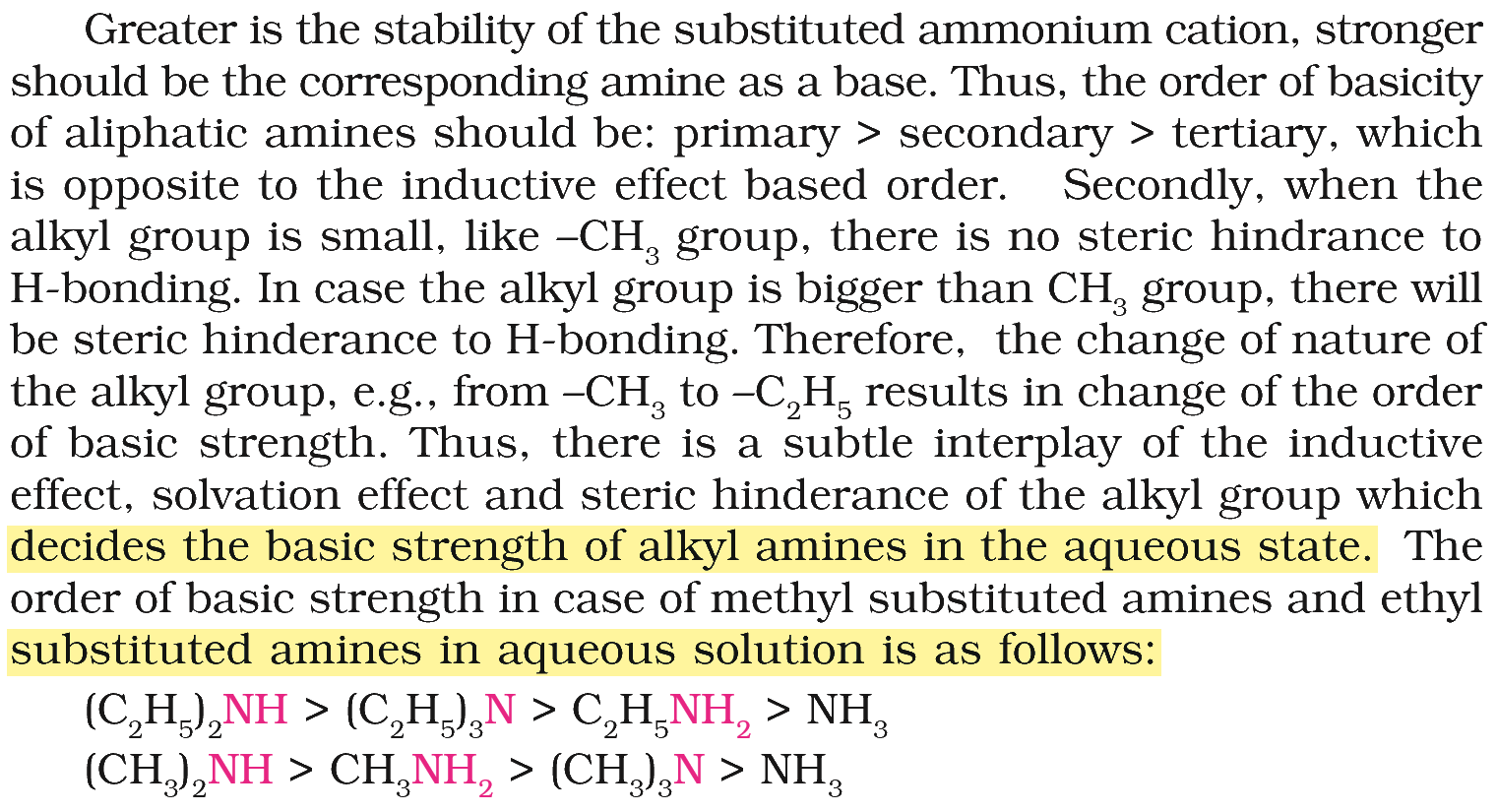
An amine is basic because the lone pair on nitrogen can accept a proton. The more available this lone pair, and the more stable the protonated amine, the stronger the base. In water, three factors decide the basic strength of aliphatic amines:
Inductive effect (+I): alkyl groups push electrons towards nitrogen and make the lone pair more available: 3° > 2° > 1°.
Solvation: the protonated amine is stabilised by hydrogen bonding with water. More N–H hydrogens mean better solvation: 1° > 2° > 3°.
Steric hindrance: bulky alkyl groups hinder this hydrogen bonding: 1° > 2° > 3° on this count.
Diethylamine is a secondary amine and is the strongest base of the four given compounds (pKb 3.00).
Why the other options are incorrect
Option (2) ethylamine — Incorrect. A primary amine with only one electron releasing ethyl group; it is a weaker base than diethylamine (pKb 3.29).
Option (3) aniline — Incorrect. The lone pair on nitrogen is delocalised into the benzene ring by resonance, so it is much less available. Aniline is weaker than ammonia (pKb 9.38).
Option (4) ammonia — Incorrect. It has no electron releasing alkyl group, so it is weaker than both aliphatic amines (pKb 4.75).
NCERT (2026-27 edition):
Chemical Reactions – …