
In the figure, aggregate demand falls from AD0 to AD1 because investment falls by 40. The marginal propensity to consume is 0.75.
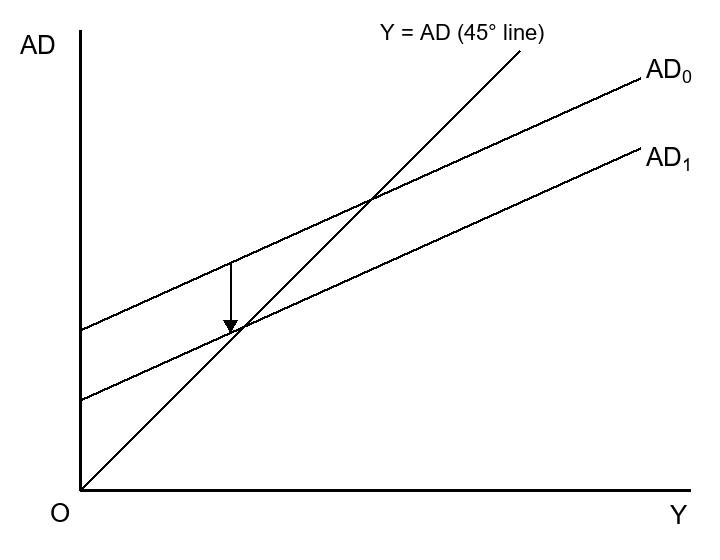
Through discretionary fiscal policy, by how much must the government raise its spending to bring aggregate demand back to AD0?
Answer & explanation
Correct answer: option 4
The correct answer is Option (4) → 40
To keep aggregate demand at AD0, autonomous expenditure must stay the same. If investment falls by 40, government spending must rise by the same 40. This deliberate step is discretionary fiscal policy.
Option (2) 160 — this is the fall in income the drop in investment would cause (4 × 40) if nothing were done. The rise in G needed is only the fall in autonomous spending, 40.
NCERT (2026-27): “Box 5.1: Fiscal Policy … We note that these fiscal policy instruments can be varied to offset the effects of undesirable shifts in investment demand. That is, if investment falls from I0 to I1, government spending can be raised from G0 to G1 so that autonomous expenditure (C + I0 + G0 = C + I1 + G1) and equilibrium income remain the same. This deliberate action to stabilise the economy is often referred to as discretionary fiscal policy to distinguish it from the inherent automatic stabilising properties of the fiscal system. …” |