During the 1967 food crisis, the zoning policy of the government refers to:
Answer & explanation
Correct answer: option 3
The correct answer is Option (3) → Prohibition of trade of food across the states
Option (1) Free flow of food across the states — Incorrect. Zoning did the opposite: it stopped food from moving from one state to another.
Option (2) Importing Wheat and Rice — Incorrect. The government had to import wheat and accept foreign aid as a consequence of the food crisis.
Option (3) Prohibition of trade of food across the states — Correct. The government had ‘zoning’ policies that prohibited trade of food across states; in Bihar, where the crisis was felt most, this reduced the availability of food dramatically.
Option (4) Exporting food items — Incorrect.
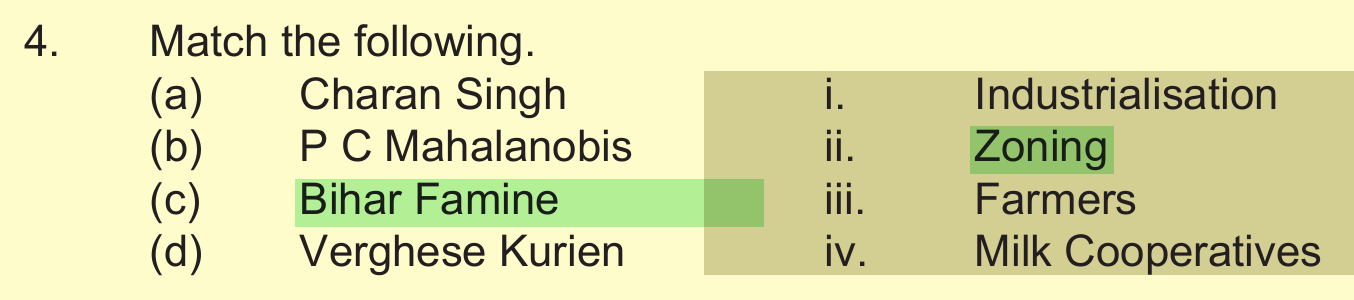
Note: The box ‘Food Crisis’ in the chapter ‘Politics of Planned Development’ was there in the pre-rationalised NCERT; this portion has been deleted from subsequent editions of NCERT, including the NCERT book (2026-27), though the chapter is still there. The 2023-24, 2025-26 and 2026-27 books still list ‘Bihar Famine’ and ‘Zoning’ in a match-the-following exercise.
NCERT (2026-27): Politics in India since Independence — Chapter 3: Politics of Planned Development
NCERT (Pre-rationalised): “…It was in Bihar that the food-crisis was most acutely felt as the state faced a near-famine situation. The food shortage was significant in all districts of Bihar, with 9 districts producing less than half of their normal output. Five of these districts, in fact, produced less than one-third of what they produced normally. Food deprivation subsequently led to acute and widespread malnutrition. It was estimated that the calorie intake dropped from 2200 per capita per day to as low as 1200 in many regions of the state (as against the requirement of 2450 per day for the average person). Death rate in Bihar in 1967 was 34 higher than the number of deaths that occurred in the following year. Food prices also hit a high in Bihar during the year, even when compared with other north Indian states. For wheat and rice the prices in the state were twice or more than their prices in more prosperous Punjab. The government had ‘zoning’ policies that prohibited trade of food across states; this reduced the availability of food in Bihar dramatically. In situations such as this, the poorest sections of the society suffered the most. The food crisis had many consequences. The government had to import wheat and had to accept foreign aid, mainly from the US. Now the first priority of the planners was to somehow attain self-sufficiency in food.…” |