CUETMOCK
  • Pricing
  • Mentors
Log inStart freeStart free mocks→

First test, then trust

Try a free CUET mock test.

Join 5,00,000+ students who rehearsed exam day on the exact NTA screen before sitting CUET. On the web and on Android.

Start free mocks →Get the Android app
CUETMOCK

India's #1 CUET Mock Test Platform. Original NCERT-based questions on the exact NTA exam screen — trusted by 5,00,000+ students since CUET 2022.

Get it onGoogle PlayScan to download the CUETMOCK app

Mock tests

  • CUET mock test series
  • Browse all papers
  • Commerce mocks
  • Humanities (Arts) mocks
  • Science mocks
  • Languages & GAT mocks
  • Free practice questions
  • Pricing

Resources

  • CUET exam guide
  • CUET syllabus
  • Universities accepting CUET
  • Expert blogs
  • News & notifications
  • Webinars & counselling
  • CUET score calculator
  • How we estimate your rank
  • FAQs

Company

  • About us
  • Our leadership & team
  • Our toppers
  • Mentors
  • For schools
  • Contact us
  • Terms
  • Privacy
  • Refund policy

Talk to us

+91 7696 6630 56info@cuetmock.comWhatsApp us

Our other platforms

  • JEE Mock — For IIT-JEE aspirants
  • NEET Mock — For NEET aspirants

Newsletter

Exam updates, study material and offers — no spam.

© 2026 NYC Ventures Pvt. Ltd.

701-702, Royal Business Park, Zirakpur, Punjab - 140603

  • Terms of use
  • Privacy policy
  • Refund policy
  • Contact us

iCUETMOCK is an independent preparation platform, not affiliated with the National Testing Agency (NTA). Always check exam details on the official NTA website.

  • Home
  • Mock tests
  • CUET guide
  • Pricing
  • Log in
Home/Practice questions/History
HistoryAncient India: Thinkers, Beliefs and Buildings

Arrange the major religious developments in a chronological order: (A…

Arrange the major religious developments in a chronological order:

(A) Earliest temples
(B) Early Upanishads
(C) First stupas
(D) Vedic traditions

Choose the correct answer from the options given below:

Answer & explanation+

Correct answer: option 2

The correct answer is Option (2) → (D), (B), (C), (A)

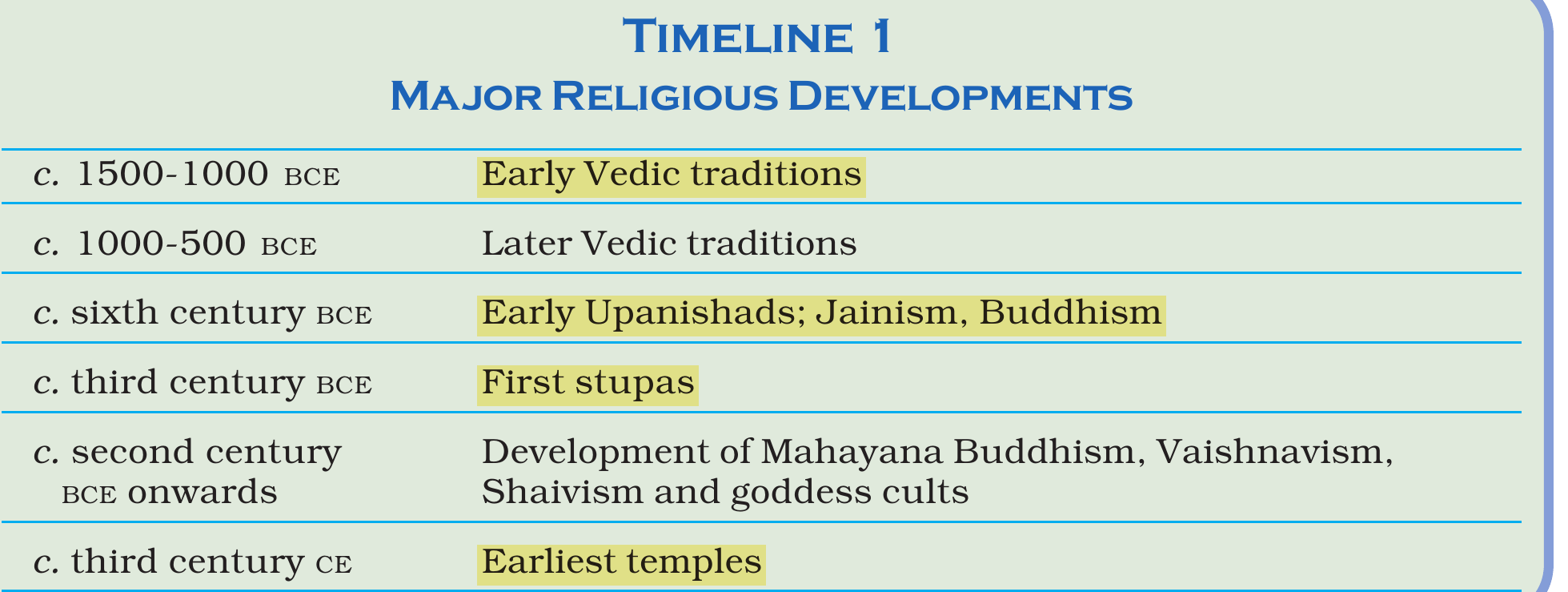
(D) Vedic traditions — c. 1500-500 BCE: Early Vedic traditions (c. 1500-1000 BCE), then Later Vedic traditions (c. 1000-500 BCE).

(B) Early Upanishads — c. sixth century BCE, the time of Jainism and Buddhism as well.

(C) First stupas — c. third century BCE.

(A) Earliest temples — c. third century CE, the last entry of the timeline of major religious developments.


NCERT: Themes in Indian History Part I — Chapter 4: Thinkers, Beliefs and Buildings (2026-27)

NCERT extract

Advertisement

Practise more on Ancient India: Thinkers, Beliefs and Buildings

Chapter-wise mocks on the real NTA exam screen, with solutions and your rank. Your first mocks are free.

Start free mocks →

Advertisement

Next questions

  1. Which of the following factors is responsible for algal blooms?English · Comprehension - (Narrative / Factual)
  2. "तुम मुझे खून दो मैं तुम्हें आज़ादी दूंगा" - यह नारा किसने दिया?Hindi · Comprehension - (Narrative / Factual)
  3. Study the given bar graph and answer the question that follows. The bar graph shows the exports of cars of type A and B (in ₹ millions) fro…General Aptitude Test · Quantitative Reasoning
  4. Which of the following statements is incorrect with reference to the Cold War?Political Science · Contemporary World Politics: The Cold War Era
  5. The need of codification is __________.Accountancy Part C · Overview of Computerised Accounting System
  6. Which of the following metals was the first to be used by men?General Aptitude Test · General Knowledge
  7. Magnetic field due to a current carrying toroid is independent of;Physics · Electromagnetic Induction
  8. Why were India, China and other developing countries exempted from the requirements of the Kyoto Protocol?Political Science · Contemporary World Politics: Environment and Natural Resources
  9. Which of the following can be a rationalising factor of (√2 + √3 + √5) ?General Aptitude Test · Quantitative Reasoning
  10. It refers to the difference between the value of combined firm and the value of the sum of the participants.Entrepreneurship · Enterprise growth Strategies