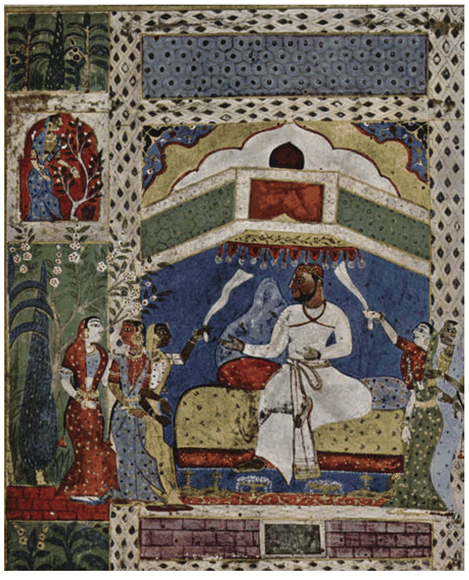
Consider the following statements on the Ahmadnagar school of Deccani painting.
(A) King sitting on the Throne is a painting from the Tarif–i–Hussain Shahi of Ahmadnagar.
(B) The high circular horizon and gold sky in these paintings show Gujarati influence.
(C) The battle scenes in the earliest volume of poems are the most striking examples of sixteenth century Deccani painting.
(D) The miniatures depicting the queen and her marriage delight us with gorgeous colours and sensuous lines.
How many of the statements given above are correct?
Answer & explanation
Correct answer: option 2
The correct answer is Option (2) → Two
A. King sitting on the Throne is a painting from the Tarif–i–Hussain Shahi of Ahmadnagar. — Correct. The painting is dated 1565–1569.
B. The high circular horizon and gold sky in these paintings show Gujarati influence. — Incorrect. The horizon and gold sky show Persian influence.
C. The battle scenes in the earliest volume of poems are the most striking examples of sixteenth century Deccani painting. — Incorrect. Most battle scenes are of no artistic interest. The feminine dress in a Ragamala series gives the most striking examples.
D. The miniatures depicting the queen and her marriage delight us with gorgeous colours and sensuous lines. — Correct. Unlike the battle scenes, which are of no artistic interest, these miniatures delight with their colours and lines.
NCERT (2026-27): “Ahmadnagar School of Painting The earliest examples of Deccani painting are in a volume of poems, celebrating the reign of Hussain Nizam Shah I of Ahmadnagar (1553–1565). Most of the 12 miniatures that illustrate battle scenes are of no artistic interest, but interestingly, those depicting the queen and her marriage delight us with gorgeous colours and sensuous lines.”
Tarif–i–Hussain Shahi: King sitting on the Throne, Ahmadnagar, 1565–1569, Bharata Itihasa Samshodaka Mandala, Poona “Ahmadnagar School of Painting …The high circular horizon and gold sky have Persian influence. We may see the debt of all Deccani kingdoms, which they owe to Persia for their landscape idiom. These feminine dress, present in a series of Ragamala paintings, are the most striking and moving examples of the sixteenth century Deccan Schools of Painting.” |