Properties of transition metals
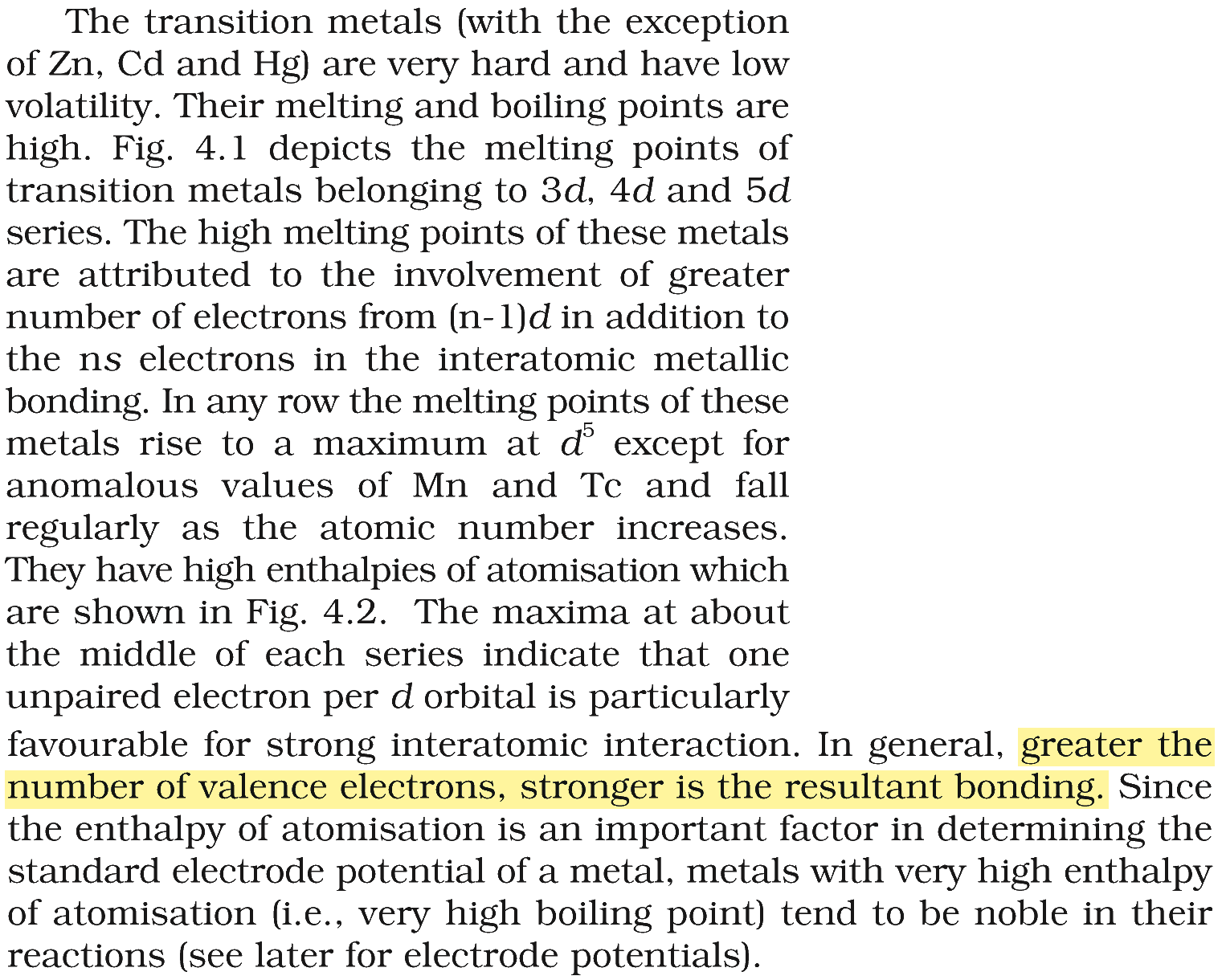
In general, the electronic configuration of outer orbitals of transition elements is (n-1)d1– 10 ns1–2. However, the electronic configurations of outer orbitals of Zn, Cd, Hg, and Cn are represented by the general formula (n-1)d1– 10 ns2. These metals are very hard and have low volatility due to high enthalpy of atomization. The more unpaired electrons, the higher the enthalpy of atomization. The stability of the half-filled d subshell in Mn2+ and the completely filled d10 configuration in Zn2+ are related to their E° values, whereas E° for Ni is related to the highest negative ΔhydH°.
Which of the following exhibits the highest enthalpy of atomization?
Answer & explanation
Correct answer: option 4
The correct answer is Option (4) → V
The enthalpy of atomisation is the energy needed to break the metal lattice into free gaseous atoms, so it measures the strength of metallic bonding. In transition metals, the unpaired (n−1)d electrons take part in metallic bonding along with the ns electrons. The more unpaired d electrons a metal has, the stronger the bonding and the higher its enthalpy of atomisation.
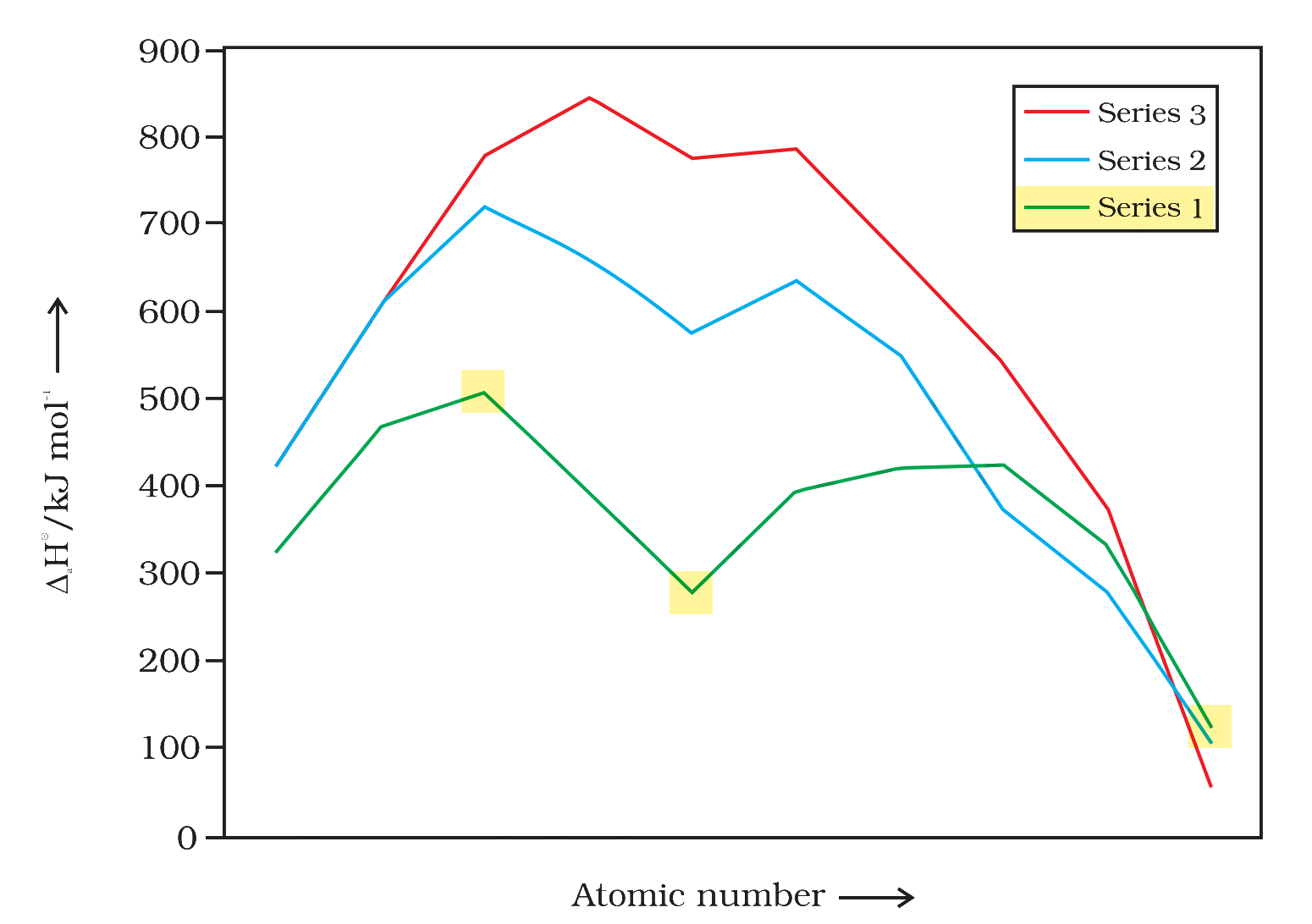
Across the 3d series, the values rise to a maximum in the first half of the series and then fall, with sharp dips at Mn and Zn:
\( \displaystyle \ce{Sc}\ 326,\ \ce{Ti}\ 473,\ \ce{V}\ 515,\ \ce{Cr}\ 397,\ \ce{Mn}\ 281 \)
\( \displaystyle \ce{Fe}\ 416,\ \ce{Co}\ 425,\ \ce{Ni}\ 430,\ \ce{Cu}\ 339,\ \ce{Zn}\ 126\quad(\mathrm{kJ\,mol^{-1}}) \)
Vanadium (Z = 23, [Ar]3d34s2) has three unpaired d electrons, all of which join in metallic bonding. So of the four metals given, V has the highest enthalpy of atomisation.
On the book’s graph of enthalpies of atomisation, the 3d metals form Series 1: its highest point is V, and it falls sharply at Mn and again at Zn.
Why the other options are incorrect
Option (1) Mn — Incorrect. Mn (Z = 25, [Ar]3d54s2) has a stable half-filled 3d5 configuration that holds its d electrons tightly. They take little part in metallic bonding, so its value (281 kJ mol−1) is unusually low.
Option (2) Sc — Incorrect. Sc (Z = 21, [Ar]3d14s2) has only one d electron for bonding, so its value is 326 kJ mol−1.
Option (3) Zn — Incorrect. Zn (Z = 30, [Ar]3d104s2) has no unpaired d electrons, so only the 4s electrons bond and it has the lowest value in the series (126 kJ mol−1).
Note: It seems that there is a mistake in the original NTA paper, which prints the outer electronic configuration of Zn, Cd, Hg and Cn as (n−1)d1–10ns2 when it should read (n−1)d10ns2, because these metals have a completely filled d subshell. The next sentence, “These metals are very hard and have low volatility due to high enthalpy of atomization”, reads as if it describes Zn, Cd and Hg, but it is true of transition metals in general. Zn, Cd and Hg are soft and fairly volatile (mercury is a liquid) and have the lowest enthalpies of atomisation, because they have no unpaired d electrons for metallic bonding.
NCERT (2026-27 edition):
Physical Properties – …