
Find the relation between \(x\) and \(y\) such that the point \((x, y)\) is equidistant from the points \((7, 1)\) and \((3, 5)\)?
Answer & explanation
Correct answer: option 3
The correct answer is Option (3) → \(x-y=2\)
A point P(x, y) equidistant from A(7, 1) and B(3, 5) has equal distances to both, so by the distance formula the squares of the two distances are equal.
Equal squared distances: \((x-7)^{2}+(y-1)^{2}=(x-3)^{2}+(y-5)^{2}\)
The \(x^{2}\) and \(y^{2}\) terms cancel: \(-14x-2y+50=-6x-10y+34\)
So \(-8x+8y=-16\), which gives the relation \(x-y=2\)
All such points lie on the perpendicular bisector of AB:
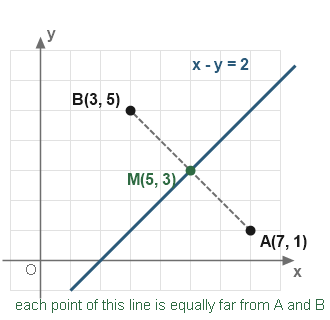
Shortcut: The midpoint of AB is equidistant from A and B, so it must satisfy the answer.
Midpoint of AB \(\displaystyle =\left(\frac{7+3}{2},\frac{1+5}{2}\right)=(5,3)\)
Only \(x-y=2\) holds at (5, 3), since \(5-3=2\); the other three left sides give 18, 8 and 7, not 5, 2 and 0