Match List I with List II
| LIST I | LIST II | ||
|---|---|---|---|
| A. | Quality factor of a circuit | I. | \( \left[R^{2}+(X_L-X_C)^{2}\right]^{\frac{1}{2}} \) |
| B. | Impedance in an ac circuit | II. | \( (\sqrt{LC})^{-1} \) |
| C. | Resonant frequency of a LCR circuit | III. | \( 0.5\,i_mV_m\sin(2\omega t) \) |
| D. | Instantaneous power supplied to a capacitor | IV. | \( (\omega_0CR)^{-1} \) |
Choose the correct answer from the options given below:
Answer & explanation
Correct answer: option 4
The correct answer is Option (4) → A-IV, B-I, C-II, D-III
Each List II entry is a standard result for a series LCR circuit or a pure capacitor in an ac circuit.
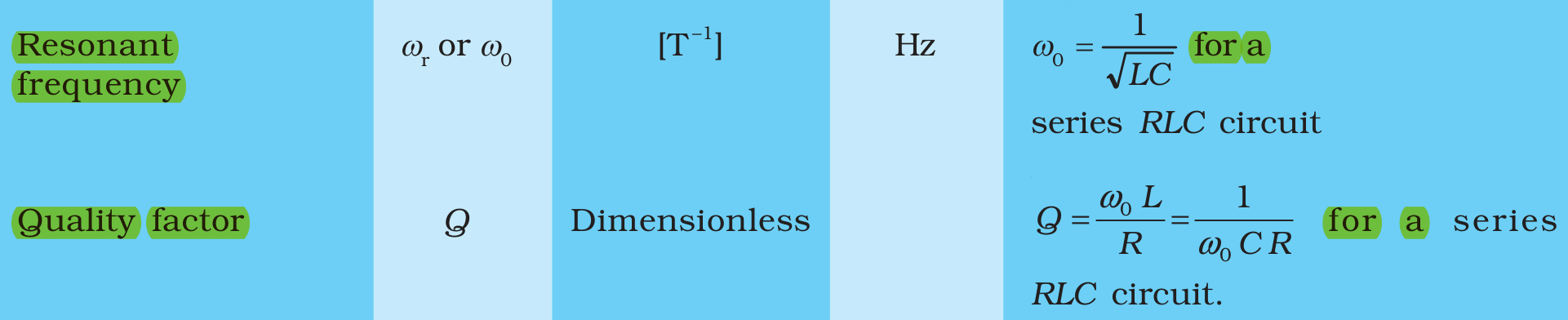
(A) Quality factor of a circuit — this matches (IV) \( (\omega_0CR)^{-1} \). The quality factor measures the sharpness of resonance, \( Q = \omega_0 L/R \); using \( \omega_0 L = 1/(\omega_0 C) \) at resonance, \( Q = 1/(\omega_0 C R) \).
(B) Impedance in an ac circuit — this matches (I) \( \left[R^{2}+(X_L-X_C)^{2}\right]^{\frac{1}{2}} \). The voltages across L and C are opposite in phase and both are at \( 90^\circ \) to the voltage across R, so the impedance is the phasor sum \( \sqrt{R^{2} + (X_L - X_C)^{2}} \).
(C) Resonant frequency of a LCR circuit — this matches (II) \( (\sqrt{LC})^{-1} \). Resonance occurs when \( X_L = X_C \), that is \( \omega_0 L = 1/(\omega_0 C) \), which gives \( \omega_0 = 1/\sqrt{LC} \).
(D) Instantaneous power supplied to a capacitor — this matches (III) \( 0.5\,i_mV_m\sin(2\omega t) \). In a capacitor the current leads the voltage by \( \pi/2 \), so with \( v = V_m\sin\omega t \) and \( i = i_m\cos\omega t \) the power is as below; it averages to zero over a cycle.
\( \displaystyle p = v\,i = V_m i_m \sin\omega t\cos\omega t = 0.5\,i_mV_m\sin(2\omega t) \)
NCERT (2026-27):
Summary – …