
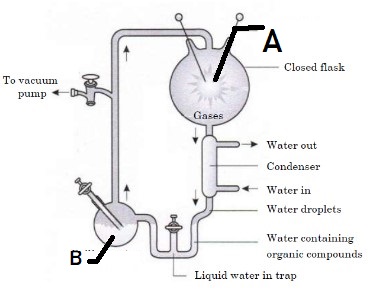
The figure given below shows Miller's experiment. Identify the parts labelled A and B.
Answer & explanation
Correct answer: option 1
The correct answer is Option (1) → A – Spark discharge, B – Boiling water
In 1953, S.L. Miller recreated the conditions of the early earth on a laboratory scale. He passed an electric discharge through CH4, H2, NH3 and water vapour in a closed flask and observed the formation of amino acids. In the figure, A points to the spark inside the closed flask and B to the heated flask at the bottom left.
Option (1) A – Spark discharge, B – Boiling water — Correct. A is the spark discharge between the electrodes, which supplies energy to the gases. B is the flask of boiling water, which sends water vapour up into the apparatus.
Option (2) A – Boiling water, B – Spark discharge — Incorrect. This swaps the two parts. The spark is in the closed flask at the top (A), and the boiling water is in the lower flask (B).
Option (3) A – Condenser, B – Water containing organic compounds — Incorrect. The condenser is on the tube below the closed flask, where water flows in and out to cool the gases. The water containing organic compounds collects in the U-shaped bend, not in flask B.
Option (4) A – Spark discharge, B – Liquid water in trap — Incorrect. A is right, but the liquid water in the trap lies in the U-shaped bend at the bottom, not in the flask marked B.
Note: Every label of Figure 6.1 can turn into an option, as this question shows. Spend a minute with the Miller diagram and name each part without looking.
NCERT Extract:
Origin of Life – “… In 1953, S.L. Miller, an American scientist created similar conditions in a laboratory scale (Figure 6.1). He created electric discharge in a closed flask containing CH4, H2, NH3 and water vapour at 800°C. He observed formation of amino acids. In similar experiments others observed, formation of sugars, nitrogen bases, pigment and fats.”
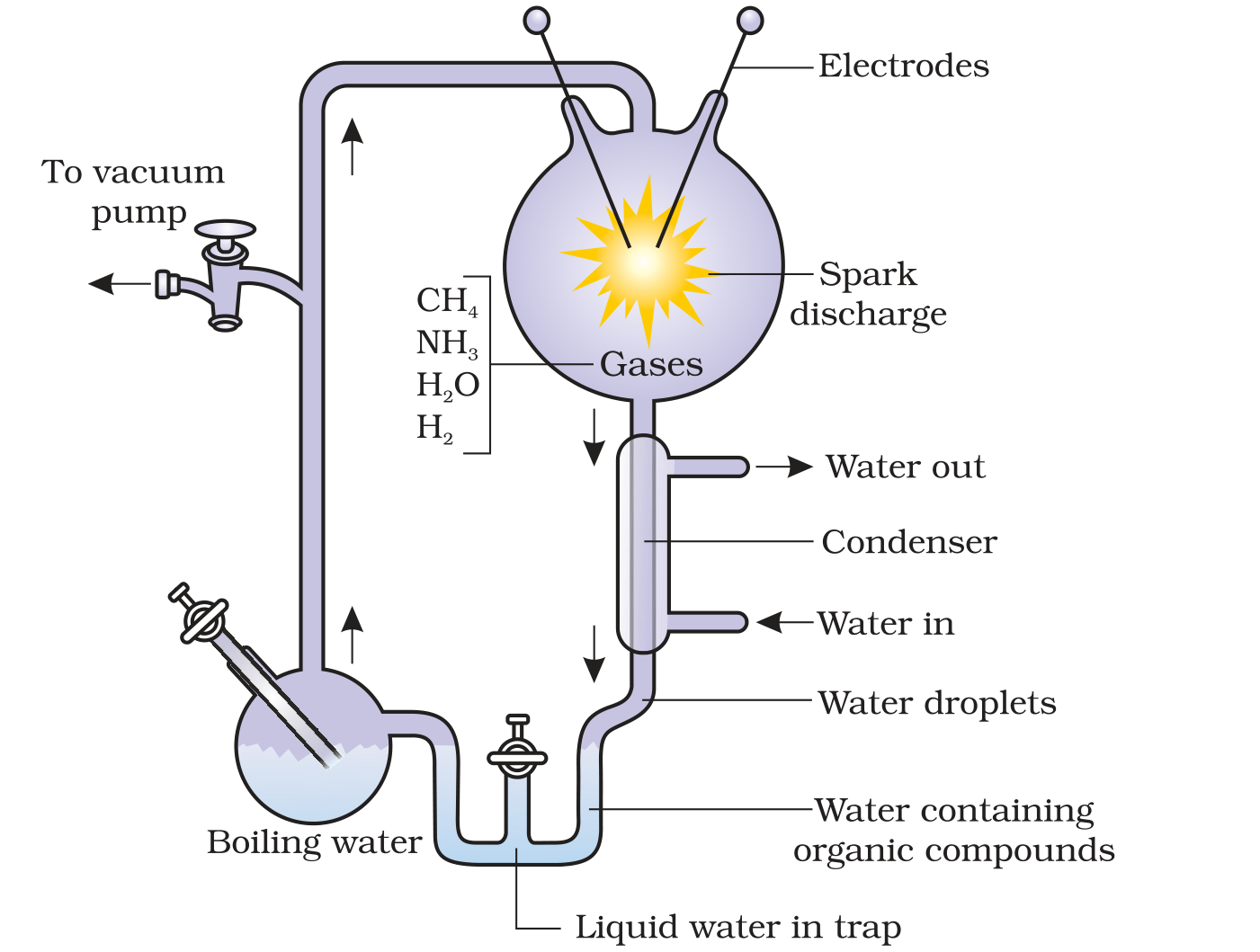
Figure 6.1 Diagrammatic representation of Miller’s experiment