
Match List-I with List-II.
| List-I (Binary solution) | List-II (Behaviour and its cause) |
|---|---|
| (A) Phenol and aniline | (I) Positive deviation; molecules of one liquid get in between the hydrogen-bonded molecules of the other and break some of these hydrogen bonds |
| (B) Chloroform and acetone | (II) Nearly ideal; the A–A and B–B attractive forces are nearly equal to the A–B forces |
| (C) Ethanol and acetone | (III) Negative deviation; hydrogen bonding between an O–H proton of one liquid and the lone pair on the nitrogen atom of the other is stronger than that between similar molecules |
| (D) n-Hexane and n-heptane | (IV) Negative deviation; the hydrogen of a C–H bond of one liquid forms a hydrogen bond with the oxygen of the C=O group of the other |
Choose the correct answer from the options given below:
Answer & explanation
Correct answer: option 4
The correct answer is Option (4) → A-III, B-IV, C-I, D-II
Whether two liquids form an ideal solution depends on how the A–B attractions compare with the A–A and B–B attractions. Weaker A–B attractions let molecules escape more easily (higher vapour pressure, positive deviation); stronger ones hold them back (lower vapour pressure, negative deviation).
(A) Phenol and aniline — This matches (III) Negative deviation; hydrogen bonding between an O–H proton of one liquid and the lone pair on the nitrogen atom of the other is stronger than that between similar molecules. The phenolic proton (O–H) forms a hydrogen bond with the lone pair on the nitrogen atom of aniline, and this bond is stronger than the hydrogen bonding between similar molecules. So the solution shows negative deviation.
(B) Chloroform and acetone — This matches (IV) Negative deviation; the hydrogen of a C–H bond of one liquid forms a hydrogen bond with the oxygen of the C=O group of the other. The C–H hydrogen of chloroform forms a hydrogen bond with the oxygen of the C=O group of acetone. This lowers the escaping tendency of both, so the solution shows negative deviation. Neither liquid has an O–H group or a nitrogen atom, so (III) does not fit.
(C) Ethanol and acetone — This matches (I) Positive deviation; molecules of one liquid get in between the hydrogen-bonded molecules of the other and break some of these hydrogen bonds. Pure ethanol is hydrogen bonded; acetone molecules get in between the ethanol molecules and break some of these bonds, so the solution shows positive deviation.
(D) n-Hexane and n-heptane — This matches (II) Nearly ideal; the A–A and B–B attractive forces are nearly equal to the A–B forces. The two similar alkanes have nearly equal attractive forces, so the solution is nearly ideal.
NCERT (2026-27 edition):
1.5.1 Ideal Solutions – “…If the intermolecular attractive forces between the A-A and B-B are nearly equal to those between A-B, this leads to the formation of ideal solution. A perfectly ideal solution is rare but some solutions are nearly ideal in behaviour. Solution of n-hexane and n-heptane, bromoethane and chloroethane, benzene and toluene, etc. fall into this category.”
1.5.2 Non-ideal Solutions – “…Mixtures of ethanol and acetone behave in this manner. In pure ethanol, molecules are hydrogen bonded. On adding acetone, its molecules get in between the host molecules and break some of the hydrogen bonds between them. Due to weakening of interactions, the solution shows positive deviation from Raoult’s law ….”
“…An example of this type is a mixture of phenol and aniline. In this case the intermolecular hydrogen bonding between phenolic proton and lone pair on nitrogen atom of aniline is stronger than the respective intermolecular hydrogen bonding between similar molecules. Similarly, a mixture of chloroform and acetone forms a solution with negative deviation from Raoult’s law. This is because chloroform molecule is able to form hydrogen bond with acetone molecule as shown.”
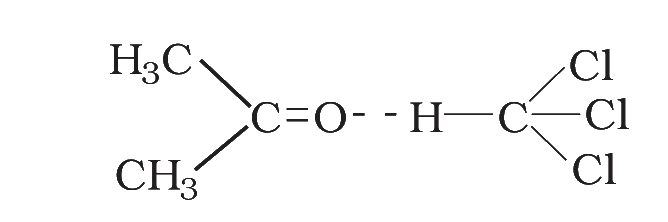
“This decreases the escaping tendency of molecules for each component and consequently the vapour pressure decreases resulting in negative deviation from Raoult’s law ….”