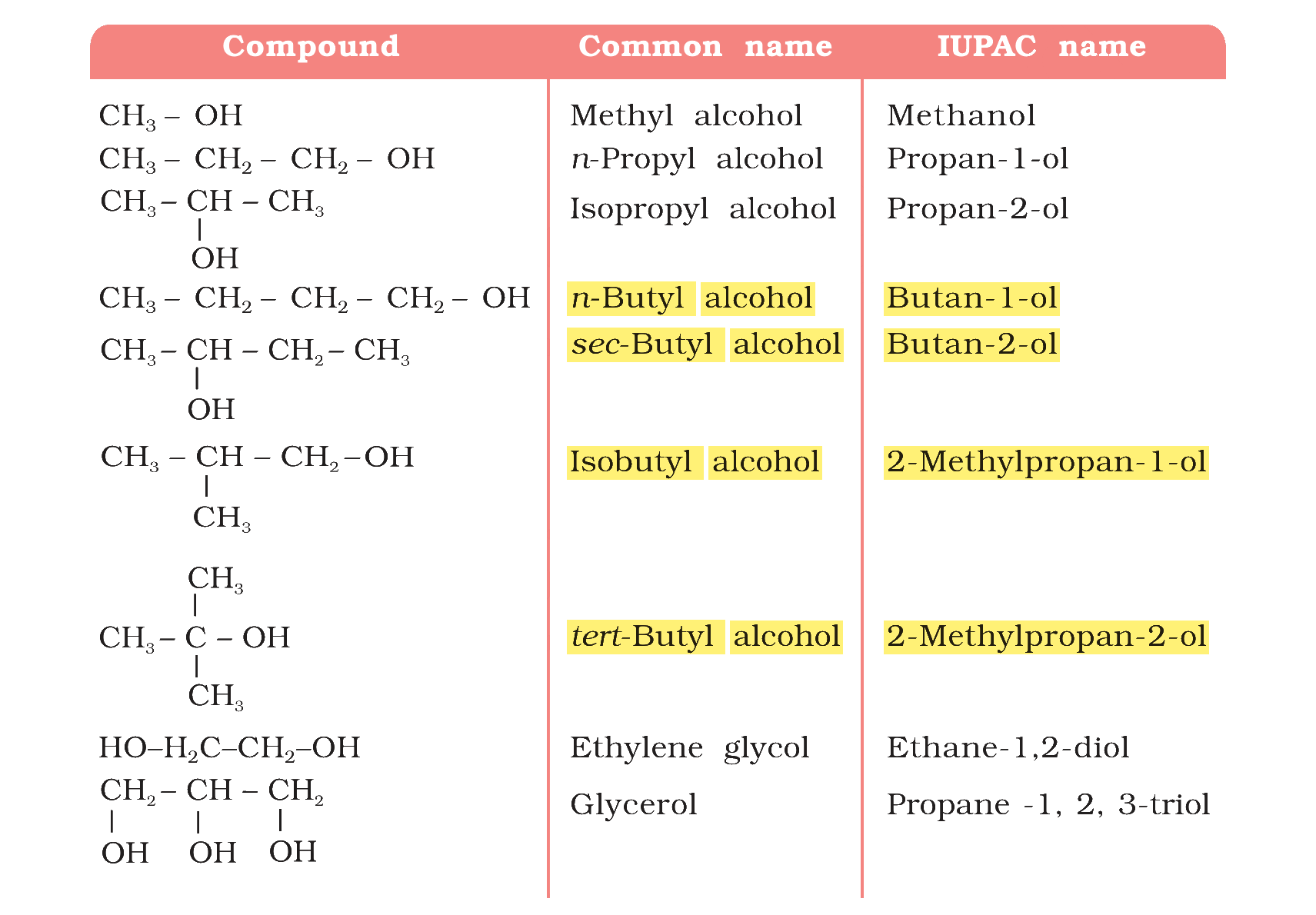
Match List-I (common name) with List-II (IUPAC name).
| List-I | List-II |
|---|---|
| (A) n-Butyl alcohol | (I) 2-Methylpropan-2-ol |
| (B) Isobutyl alcohol | (II) Butan-1-ol |
| (C) sec-Butyl alcohol | (III) Butan-2-ol |
| (D) tert-Butyl alcohol | (IV) 2-Methylpropan-1-ol |
Choose the correct answer from the options given below:
Answer & explanation
Correct answer: option 4
The correct answer is Option (4) → A-II, B-IV, C-III, D-I
The four compounds are isomers, C4H9OH. The common name is the name of the alkyl group followed by the word alcohol. In the IUPAC name, the longest chain is numbered from the end nearest to the –OH group.
(A) n-Butyl alcohol — This matches (II) Butan-1-ol. \( \ce{CH3CH2CH2CH2OH} \): a straight chain of four carbons with –OH on C-1.
(B) Isobutyl alcohol — This matches (IV) 2-Methylpropan-1-ol. \( \ce{(CH3)2CHCH2OH} \): the longest chain has three carbons, –OH on C-1 and a methyl group on C-2.
(C) sec-Butyl alcohol — This matches (III) Butan-2-ol. \( \ce{CH3CH(OH)CH2CH3} \): a straight four-carbon chain with –OH on C-2, a secondary carbon.
(D) tert-Butyl alcohol — This matches (I) 2-Methylpropan-2-ol. \( \ce{(CH3)3COH} \): the –OH group and a methyl group are both on C-2 of a three-carbon chain, a tertiary carbon.
NCERT (2026-27 edition):
7.2 Nomenclature – “(a) Alcohols: The common name of an alcohol is derived from the common name of the alkyl group and adding the word alcohol to it. For example, CH3OH is methyl alcohol.”
“According to IUPAC system, the name of an alcohol is derived from the name of the alkane from which the alcohol is derived, by substituting ‘e’ of alkane with the suffix ‘ol’. The position of substituents are indicated by numerals. For this, the longest carbon chain (parent chain) is numbered starting at the end nearest to the hydroxyl group.” … “Table 7.1 gives common and IUPAC names of a few alcohols as examples.”
Table 7.1: Common and IUPAC Names of Some Alcohols