
CUETMOCK
  • Pricing
  • Mentors
Log inStart freeStart free mocks→

First test, then trust

Try a free CUET mock test.

Join 5,00,000+ students who rehearsed exam day on the exact NTA screen before sitting CUET. On the web and on Android.

Start free mocks →Get the Android app
CUETMOCK

India's #1 CUET Mock Test Platform. Original NCERT-based questions on the exact NTA exam screen — trusted by 5,00,000+ students since CUET 2022.

Get it onGoogle PlayScan to download the CUETMOCK app

Mock tests

  • CUET mock test series
  • Commerce mocks
  • Humanities (Arts) mocks
  • Science mocks
  • Languages & GAT mocks
  • Free practice questions
  • Pricing

Resources

  • CUET exam guide
  • CUET syllabus
  • Universities accepting CUET
  • Expert blogs
  • News & notifications
  • Webinars & counselling
  • CUET score calculator
  • How we estimate your rank
  • FAQs

Company

  • About us
  • Our leadership & team
  • Our toppers
  • Mentors
  • For schools
  • Contact us
  • Terms
  • Privacy
  • Refund policy

Talk to us

+91 7696 6630 56info@cuetmock.comWhatsApp us

Our other platforms

  • JEE Mock — For IIT-JEE aspirants
  • NEET Mock — For NEET aspirants

Newsletter

Exam updates, study material and offers — no spam.

© 2026 NYC Ventures Pvt. Ltd.

701-702, Royal Business Park, Zirakpur, Punjab - 140603

  • Terms of use
  • Privacy policy
  • Refund policy
  • Contact us

iCUETMOCK is an independent preparation platform, not affiliated with the National Testing Agency (NTA). Always check exam details on the official NTA website.

  • Home
  • Mock tests
  • CUET guide
  • Pricing
  • Log in
Home/Practice questions/Chemistry
ChemistryOrganic: Haloalkanes and Haloarenes

The figure shows propan-2-ol (A) and butan-2-ol (D), each with its mi…

The figure shows propan-2-ol (A) and butan-2-ol (D), each with its mirror image and with that mirror image rotated by 180°. Structure C overlaps structure A completely, but structure F does not overlap structure D.
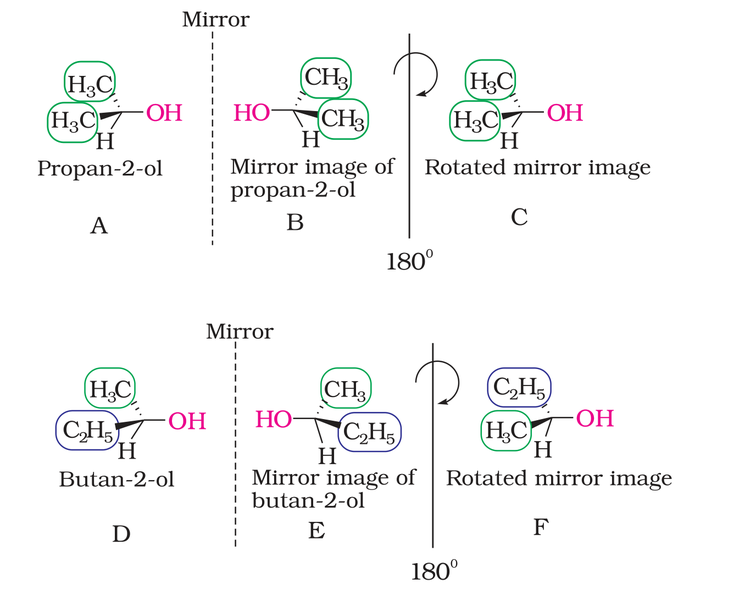
Figs. 6.5 and 6.6 Propan-2-ol and butan-2-ol with their mirror images

Which feature of the two molecules, shown by the circled groups, explains this?

Answer & explanation+

Correct answer: option 3

The correct answer is Option (3) → The central carbon of butan-2-ol carries four different groups, while that of propan-2-ol carries two identical CH3 groups.

A molecule that cannot be superimposed on its mirror image is chiral, and a carbon carrying four different groups (an asymmetric carbon) makes such a molecule.

  • Propan-2-ol (A, B, C) — the two circled groups are both CH3. The central carbon is not asymmetric, so the rotated mirror image C falls on A: the molecule is achiral.

  • Butan-2-ol (D, E, F) — the circled groups are CH3 and C2H5, with H and OH: four different groups. After rotation, CH3 of F lies where C2H5 of D lies, so F does not overlap D: the molecule is chiral.

Why the other options are incorrect

Option (1) Butan-2-ol has a larger molecular mass than propan-2-ol. — Incorrect. Mass has nothing to do with whether a molecule can be superimposed on its mirror image.

Option (2) The –OH group is on a primary carbon in butan-2-ol but on a secondary carbon in propan-2-ol. — Incorrect. In both molecules the –OH group is on carbon 2, which is a secondary carbon.

Option (4) The central carbon of butan-2-ol is sp2 hybridised, while that of propan-2-ol is sp3 hybridised. — Incorrect. The central carbon in both molecules has four single bonds; it is tetrahedral and sp3 hybridised.

NCERT (2026-27 edition):
6.7.1 Reactions of Haloalkanes (stereochemical aspects) – “…propan-2-ol (A) does not contain an asymmetric carbon, as all the four groups attached to the tetrahedral carbon are not different. We rotate the mirror image (B) of the molecule by 180° (structure C) and try to overlap the structure (C) with the structure (A), these structures completely overlap. Thus propan-2-ol is an achiral molecule.”

“Butan-2-ol has four different groups attached to the tetrahedral carbon and as expected is chiral.”

Figs. 6.5 and 6.6

Fig. 6.5: B is mirror image of A; B is rotated by 180° and C is obtained; C is superimposable on A.

Fig. 6.6: E is mirror image of D; E is rotated by 180° to get F and F is non superimposable on its mirror image D.

Advertisement

Practise more on Organic: Haloalkanes and Haloarenes

Chapter-wise mocks on the real NTA exam screen, with solutions and your rank. Your first mocks are free.

Start free mocks →

Advertisement

Next questions

  1. Which of the following disorders does Meena's condition best show?Psychology · Psychological Disorders
  2. Students of Primary, Middle, Secondary and Sr. Secondary classes collected donation for a Relief Fund as shown in the pie chart. If the don…General Aptitude Test · Quantitative Reasoning
  3. Choose the word that means the same as the given word. ObligationEnglish · Synonyms
  4. During the nineteenth century, why was it difficult for census officers to collect figures on mortality and diseases?History · Modern India: Colonial cities
  5. Statement I : The fetal ejection reflex originates from the mother's brain. Statement II : Colostrum contains maternal antibodies.Biology · Human Reproduction
  6. Three positions of a dice are given below. What will come the face opposite to the face containing '4' on it?General Aptitude Test · Verbal Reasoning
  7. Art in India from Company painting to the Haripura panels. Match the items in List-I with the facts about them in List-II.List-IList-IIA. T…Fine Arts · The Bengal School and Cultural Nationalism
  8. The total revenue of a firm is increasing at a constant rate. Which of the following is true about this firm?Economics · Micro Economics: Theory of Firms under Perfect Competition
  9. Find the value of sin(60 + θ) - cos(30 - θ).General Aptitude Test · Quantitative Reasoning
  10. Find the missing figure in given pattern:General Aptitude Test · Non-Verbal Reasoning